
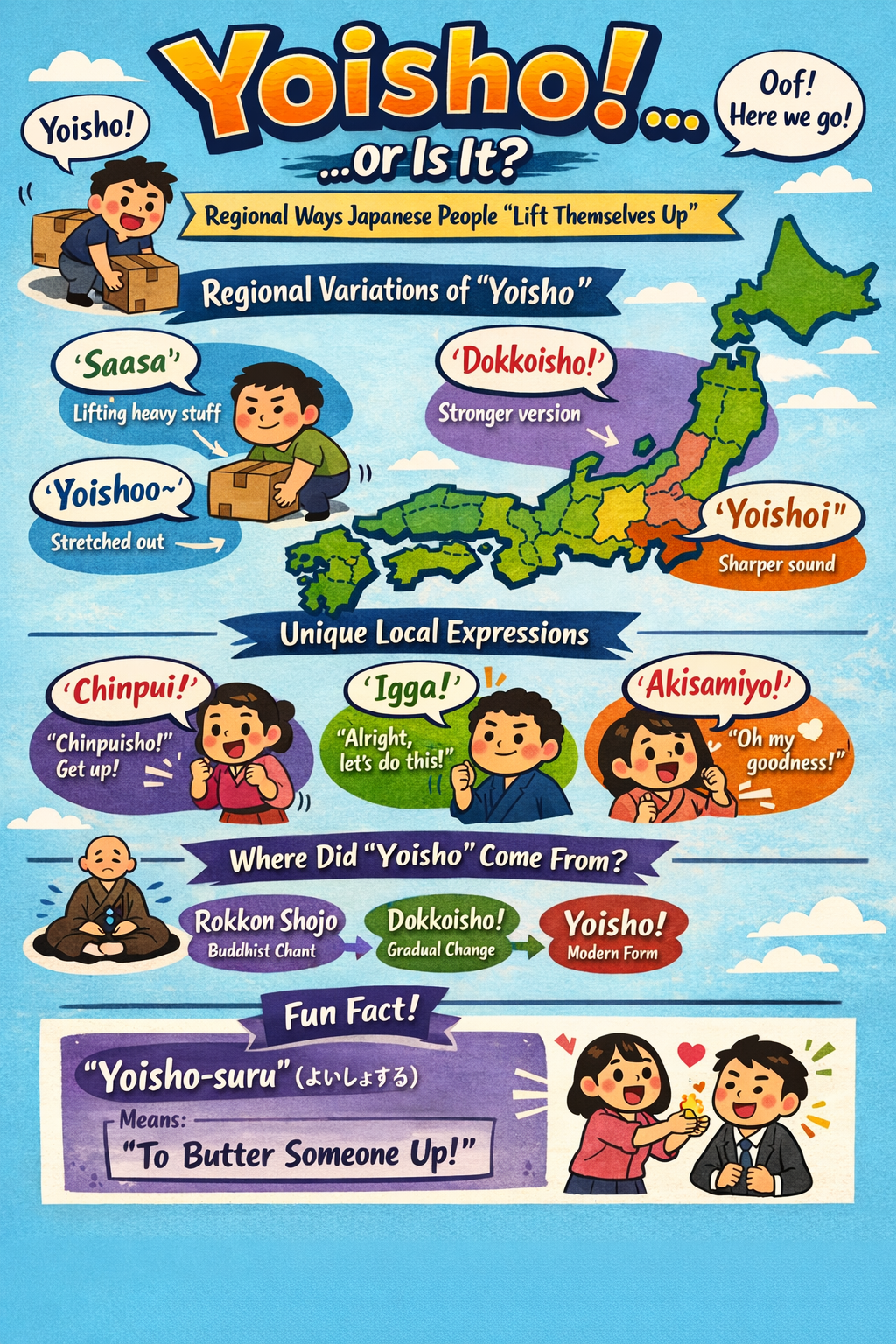
If you’ve spent any time in Japan, you’ve probably heard someone say: “Yoisho!”
It’s that little sound people make when they stand up, lift something heavy, or even just get moving after sitting too long.
In English, we might say:
“Oof!”
“Here we go…”
“Up we go!”
But in Japan, it’s usually yoisho.
Or… is it?
1. Regional Variations of “Yoisho”
In many parts of Japan, people still say “yoisho”—but it sounds a little different depending on where you are.
Tohoku (Yamagata, etc.): “Saasa”
Used when lifting something heavy.
It has a softer, almost rhythmic feel.
Hokuriku (Toyama, Ishikawa): “Dokkoisho”
A stronger, heavier-sounding version.
You can really feel the effort in the word!
Kansai: “Yoishoo~”
Same word, but stretched out with a musical tone.
Very Kansai-style—expressive and lively.
Kyushu: “Yoishoi”
A slightly sharper ending, with an added “i” sound.
2. Completely Different Local Expressions
In some places, people don’t say “yoisho” at all.
Shizuoka: “Chinpui”
A rare and unique expression.
You might hear: “Chinpuisho!” when standing up.
(Yes—it sounds almost magical!)
Kagoshima: “Igga”
Means something like:
“Alright, let’s do this!”
More energetic than “yoisho.”
Okinawa: “Akisamiyo!”
Originally an expression of surprise (“Oh my goodness!”),
but often used like a sigh or grunt when moving.
3. Where Does “Yoisho” Come From?
Here’s something interesting.
One popular theory is that “yoisho” comes from a Buddhist chant:
Rokkon Shōjō (六根清浄) meaning “purification of the six senses.”
Over time, this chant changed:
Rokkon Shōjō → Dokkoisho → Yoisho
So every time someone says “yoisho,” they might (very indirectly!) be echoing an ancient religious phrase.
Fun Fact
There’s also a verb: yoisho-suru (よいしょする)
This doesn’t mean “to lift something.”
It means “to flatter someone / butter them up” and comes from the idea of “lifting someone up”… but with words instead of muscles!
Final Thought
“Yoisho” may seem like a small, simple word, but it’s a great example of how:
Language reflects daily life
Dialects add personality
Even tiny expressions have deep roots
So next time you stand up and say “yoisho”… remember—you’re part of a long linguistic tradition.