
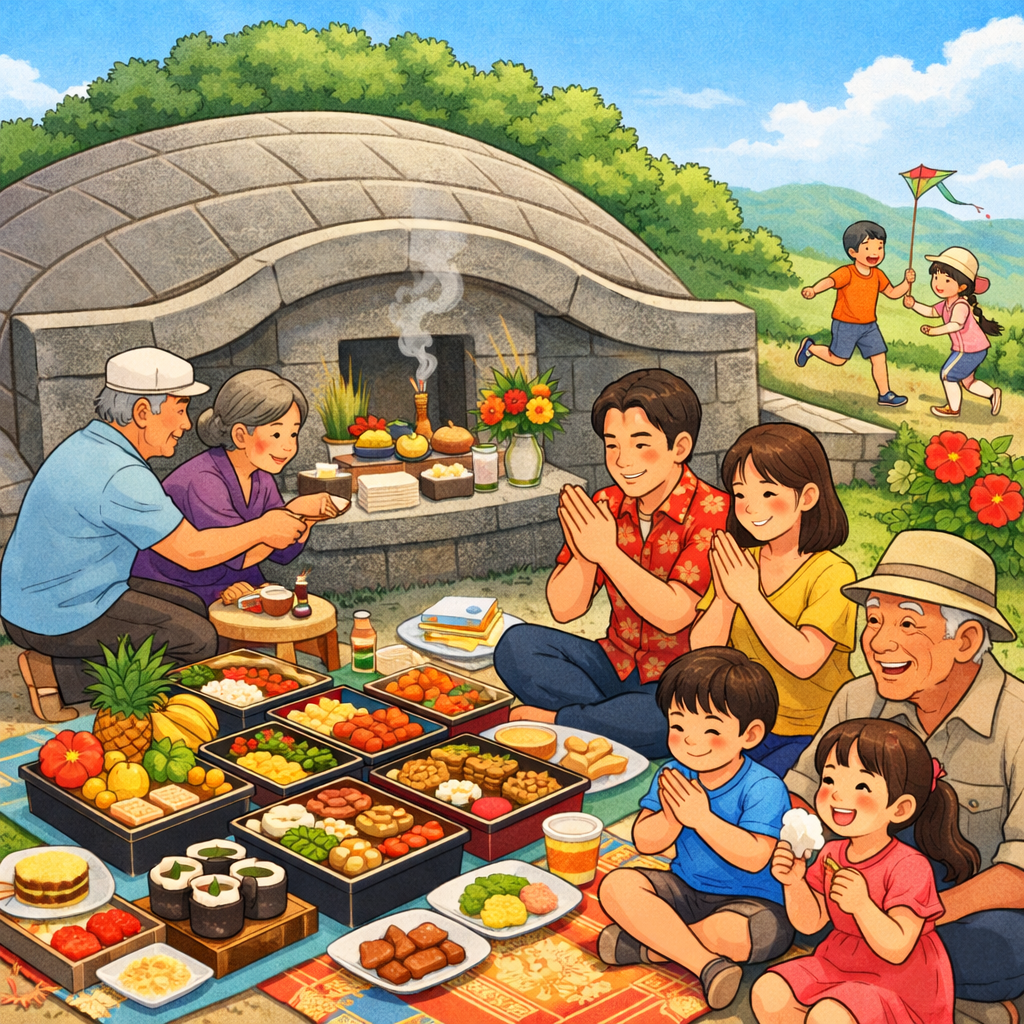
Every spring in Okinawa, something unusual happens.
Families gather at cemeteries—not to mourn quietly, but to eat, laugh, and spend time together.
This special tradition is called シーミー (Shīmī), and it is one of the most fascinating cultural customs in Japan.
In 2026, シーミー takes place between April 5 and April 19, depending on the family.
What Is シーミー?
シーミー (清明祭) is an annual Okinawan festival that honors ancestors. It is held during the 清明 (Seimei) season, which marks the arrival of warm spring weather.
Unlike grave visits in mainland Japan, which are usually quiet and short, シーミー is lively and social.
Think of it as:
A grave visit
A family reunion
A spring picnic
—all at the same time.
The Most Surprising Part: A Picnic at the Tomb
The most famous feature of シーミー is the family picnic at the cemetery.
Families bring large boxes of food and place them in front of the ancestral tomb. After offering prayers, everyone sits down and eats together.
Typical foods include:
Braised pork belly (三枚肉)
Fish cakes (かまぼこ)
Kelp rolls (昆布巻き)
Okinawan rice (じゅーしー)
Mochi sweets
These foods are first offered to the ancestors and then shared by the family.
For many visitors, seeing dozens of people eating together at a graveyard can be surprising—but in Okinawa, it feels completely natural.
Okinawa’s Unique Tombs
Another striking feature of シーミー is the size and shape of Okinawan tombs.
Many families use large tombs called 亀甲墓 (kamekō-baka), or “turtle-back tombs.”
These tombs:
Are shaped like a turtle shell
Are much larger than mainland Japanese graves
Have open space in front for family gatherings
In fact, they were designed specifically to allow large family ceremonies like シーミー.
A Gathering of Generations
シーミー is not just a religious ceremony—it is also a family reunion.
Sometimes dozens of relatives attend:
Grandparents lead prayers
Parents prepare food
Children run around and play
Cousins meet relatives they rarely see
For many families, this is one of the few times each year when everyone gathers together.
When Does シーミー Happen?
Unlike most holidays, シーミー does not happen on a single day.
Instead:
It takes place during the Seimei season
Each family chooses its own day
Many families meet on weekends
Sundays are often the busiest days
During this time, roads near cemeteries can become crowded, and hillsides fill with families and picnic blankets.
Where Did This Tradition Come From?
シーミー has deep historical roots.
It developed from a mixture of:
Traditional Okinawan ancestor worship
Chinese customs honoring ancestors
Later Japanese religious influences
This blend reflects Okinawa’s long history as part of the former Ryukyu Kingdom, which maintained close ties with China.
A Celebration of Life, Not Just Memory
One of the most beautiful things about シーミー is its atmosphere.
Instead of sadness, there is:
Conversation
Laughter
Shared meals
Stories about family history
The idea is simple: ancestors are still part of the family, and gathering together keeps their memory alive.
A Unique Cultural Experience
If you ever visit Okinawa in April, you may notice large groups of people gathered at tombs with picnic food.
At first, it might seem unusual—but once you understand the meaning, it becomes something truly moving.
シーミー is not just about remembering the past.
It is about celebrating family, tradition, and connection across generations.
And that makes it one of the most unforgettable customs in Japan.