
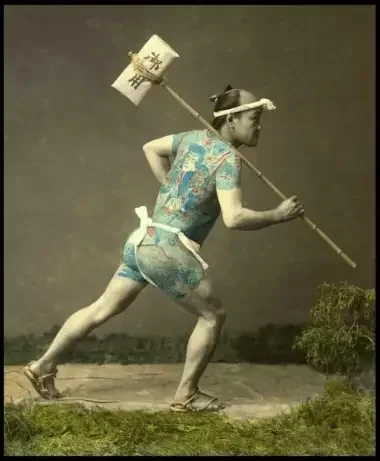
America had the Pony Express. In Japan they had the Hikyaku.
Imagine a feudal Japanese version of FedEx, but instead of delivery trucks, you have incredibly athletic men sprinting across the country in loincloths.
Those were the Hikyaku (飛脚), which literally translates to "flying legs." They were the backbone of Japan's communication and transport network during the Edo period (1603–1867), connecting the shogun's capital in Edo (modern-day Tokyo) with the imperial capital in Kyoto and the commercial hub of Osaka.
Here is a breakdown of how these legendary runners operated:
The System: Speed and Stamina
The Hikyaku didn't just run a marathon and call it a day; they operated on a highly efficient relay system.
The Relay Network: The main highway, the Tokaido, had 53 government-sanctioned post stations (shukuba). A runner would sprint at top speed from one station to the next, hand off the documents or package to a fresh runner, and the cycle would continue.
The Pace: While a normal traveler took about two weeks to walk from Edo to Kyoto, the fastest express Hikyaku could make the roughly 300-mile (490 km) journey in just 3 to 4 days. That means the network was moving at an average pace of around 75 to 100 miles per day, operating day and night.
The "Uniform" and Gear
If you saw a Hikyaku coming, you knew it. They traveled incredibly light to maximize speed:
Minimal Clothing: They typically wore only a fundoshi (loincloth) and straw sandals (waraji). Because they wore so little, many Hikyaku sported elaborate, full-body tattoos (irezumi) featuring dragons, deities, or koi fish, which served as a sort of artistic "clothing" and showed off their masculine pride.
The Mail Stick: They carried a bamboo pole over their shoulder. Attached to the front was a small box or packet containing the letters, and attached to the back was a small bundle of spare sandals, since running on rough roads tore through straw footwear rapidly.
The Bells: They often attached bells to their poles. The jingling cleared a path through crowds and signaled the next relay station that a runner was incoming, allowing the next guy to prep and start running before the handoff even occurred.
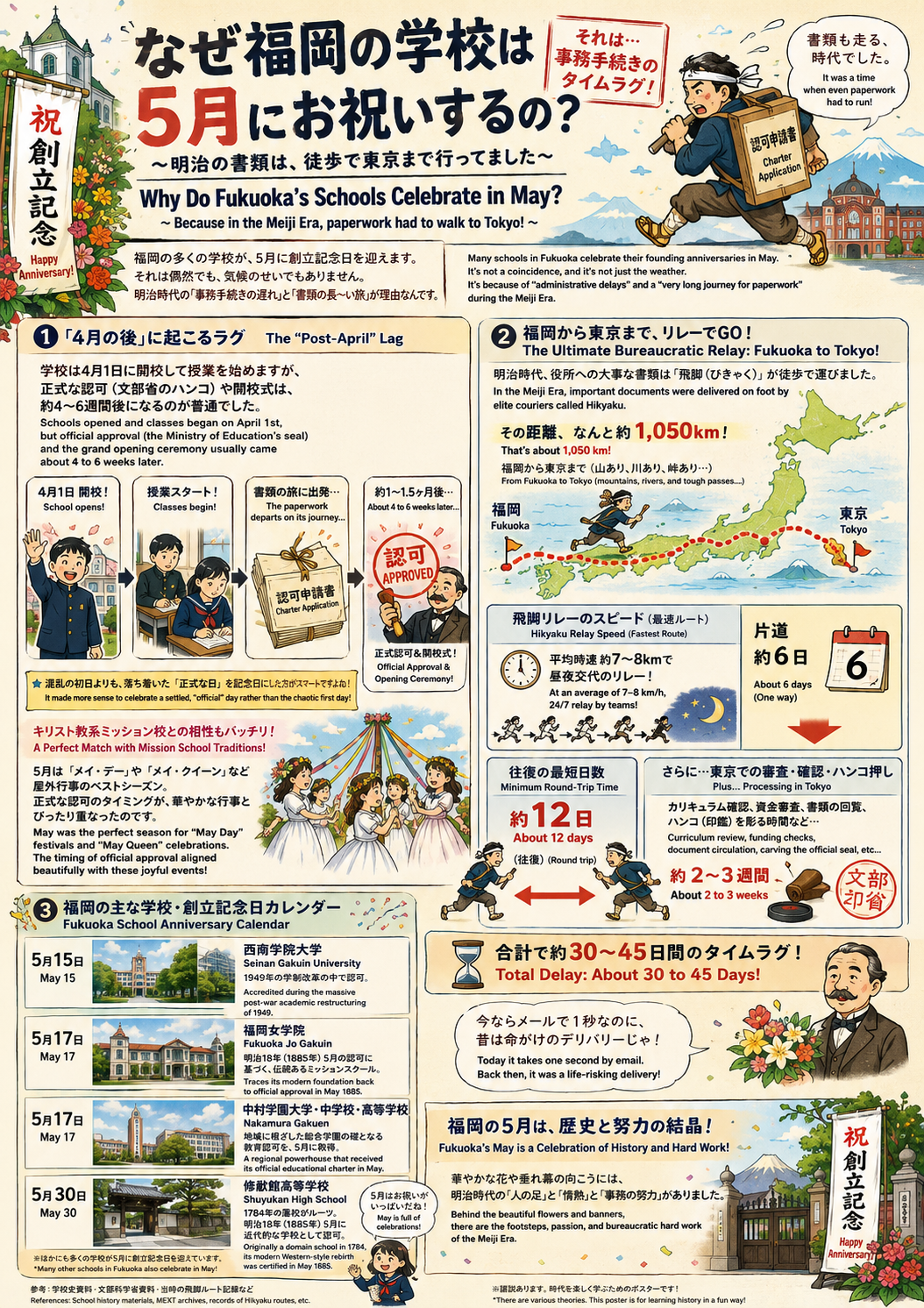
The May Miracle: Why Fukuoka’s Schools Are All Celebrating Right Now
Exploring the history, administrative lag, and the grueling 1,000km charter run of the Meiji Era
If you walk through the streets of Nishijin or Sawara this week, you’ll notice something vibrant in the air. It’s not just the scent of early summer—it’s the sight of flower stands, festive banners, and students in crisp new uniforms. In Fukuoka, May isn't just a month; it’s Anniversary Season.
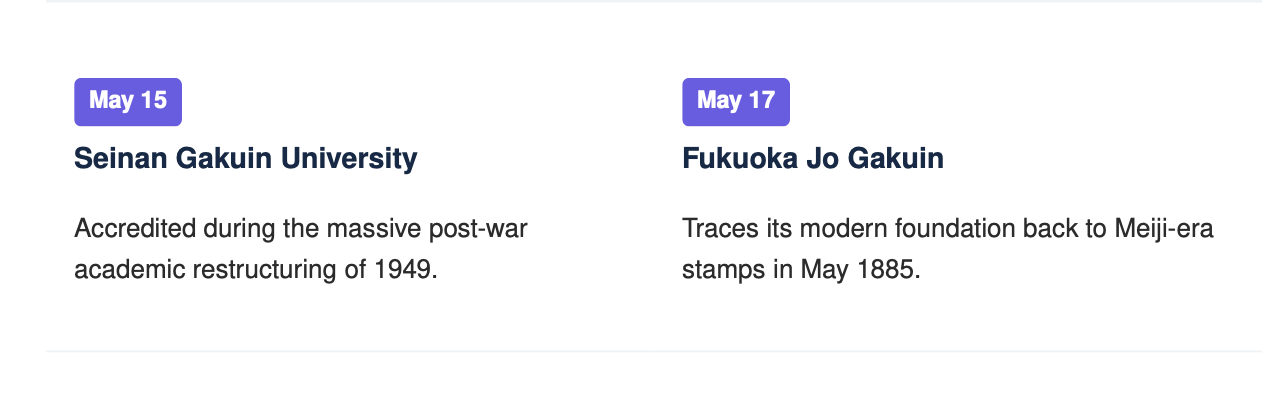
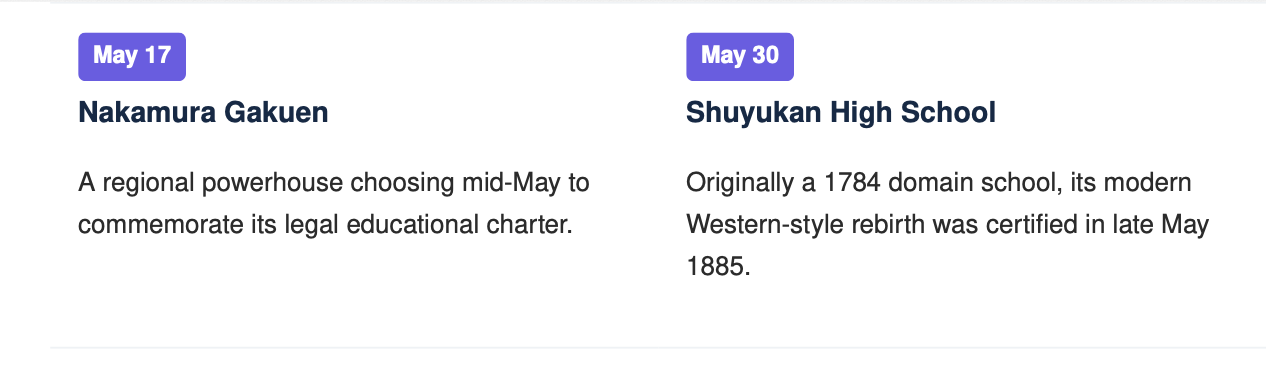
From the historic gates of Shuyukan to the sprawling campuses of Seinan Gakuin and Nakamura Gakuen, a massive cluster of Fukuoka’s most prestigious institutions hold their founding celebrations in May. While culture and weather play a role, the core explanation comes down to an intriguing bureaucratic phenomenon: The Post-April Administrative Delay.
1. The Mechanics of the "Post-April" Lag
Since 1886, Japan’s fiscal and academic calendars have strictly kicked off on April 1st. Naturally, you would expect a school's anniversary to land on its first day of classes. However, in the Meiji (1868–1912) and early Showa (1926–1989) eras, opening a school was an administrative labyrinth.
A school would open its doors, admit its inaugural class, and begin instruction in April. But the official government charter, the final legal stamps from the Ministry of Education in Tokyo, and the scheduling of a grand opening ceremony routinely dragged out for four to six weeks. Rather than celebrating the chaotic first day of school, institutions permanently anchored their "Founding Days" to the day the official paperwork was finalized and the campus had finally settled into its routine—pushing the celebrations directly into mid-to-late May.
The "Missionary Belt" Synergy
This administrative lag perfectly aligned with the Western cultural traditions of local Christian mission schools. For institutions like Fukuoka Jo Gakuin, May was the prime
time for "May Day" festivals. The arrival of the formal charter matched perfectly with outdoor pageants, Maypole dancing, and the crowning of the "May Queen."
2. The Ultimate Bureaucratic Relay: From Fukuoka to Tokyo
To truly appreciate this delay, we have to look at the physical reality of governance in early modern Japan. Before the telegraph and the rail networks completely bound the nation together, official documents had to travel by foot. If a Fukuoka school needed its charter approved by the central government in Tokyo (formerly Edo), it relied on the elite courier system known as Hikyaku (飛脚).
The overland route via the historic Sanyodo and Tokaido highways spans roughly D ≈ 1,050 ext{ km} (approx. 650 miles). How long did this monumental legal errand take?
The Physics of a Meiji Paperwork Run
Ordinary travelers typically required about 30 days to walk from Fukuoka to Tokyo. However, an elite, multi-stage relay system of professional runners (Tsugi-hikyaku) could sustain a punishing, around-the-clock pace.
Operating at an average speed of v ≈ 7 ext{ to } 8 ext{ km/h} across rugged mountain passes and river crossings, a dedicated express relay could complete a one-way trip in approximately 6 days.
Therefore, the minimum theoretical transit time for a charter's round trip was:
T_{ ext{transit}} = 6 ext{ days (Express Out)} + 6 ext{ days (Express Back)} = 12 ext{ days}
When you factor in standard bureaucratic processing time within the Tokyo ministries—reviewing curricula, verifying funding, and physically carving and applying the official seals—an additional 2 to 3 weeks was easily added to the timeline. When accounting for this intense 12-day physical journey across Honshu and the subsequent bureaucratic gears grinding in Tokyo, a 30-to-45-day delay between a school's actual April opening and its official May charter becomes remarkably impressive for the era.
The Fukuoka Anniversary Calendar
The next time you spot the massive floral arrangements and celebratory banners outside a school gate in Fukuoka this month, you aren't just looking at a modern school holiday. You are witnessing the beautiful intersection of Meiji-era logistics, grueling trans-Japan foot relays, and the enduring legacy of early bureaucracy.
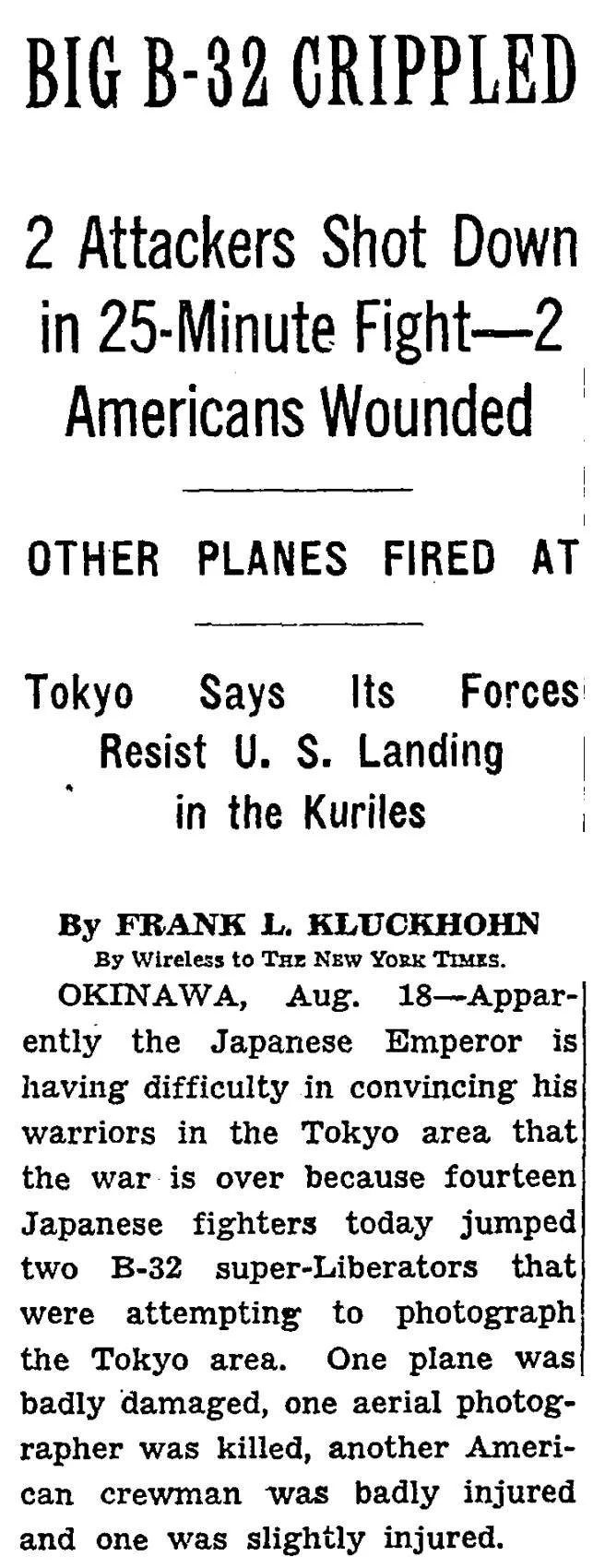
Fighting in the Pacific Theater Post August 15
Despite the "Broadcast of the Jeweled Voice [of the Emperor]" (玉音放送) on 15 August 1945, in reality, fighting in the Pacific theater continued for days. Curiously, I don't think many, if any, Japanese alive today know this.
The 玉音放送 (Gyokuon Hōsō, “Broadcast of the Jeweled Voice”) aired on 15 August 1945 was Emperor Hirohito’s radio broadcast announcing Japan’s acceptance of the Potsdam Declaration and surrender.
Despite that unprecedented announcement, fighting did not immediately stop. Many Japanese forces abroad never even heard the broadcast, communications broke down, and in some cases local commanders refused to accept it.
Some examples of what happened after the Gyokuon Hōsō:
China and Southeast Asia: Fighting continued for days and even weeks. Japanese units in China, French Indochina, and the Dutch East Indies sometimes resisted surrender, partly due to poor communication and partly out of defiance.
Manchuria: The Soviet invasion had only just begun (August 9 onward), and large-scale fighting continued well after August 15. In fact, Japanese forces there formally surrendered only on September 2, the same day as the Tokyo Bay ceremony aboard USS Missouri.
Okinawa and isolated islands: Even in the Pacific islands, many soldiers fought on or remained in hiding for weeks, months, and in some cases decades (famously the “holdouts” like Hiroo Onoda, who didn’t surrender until 1974 in the Philippines).
Casualties after surrender: There were still skirmishes and killings of both Japanese and Allied soldiers in the days following the broadcast, sometimes because word hadn’t reached isolated units, sometimes because of disbelief or unwillingness to accept surrender.
August 15, 1945 – Emperor’s Broadcast
Hirohito’s Gyokuon Hōsō announces surrender.
Many Japanese soldiers and civilians cannot understand the archaic court Japanese, and commanders have to “interpret” the message for their men.
Some officers refuse to believe it, suspecting a trick.
August 16–17
China & Manchuria: Fighting with the Soviets intensifies. The Red Army pushes deep into Manchuria, Korea, Sakhalin, and the Kuriles.
Indochina & Dutch East Indies: Local Japanese garrisons fight on, both because of poor communications and to maintain order until Allies arrive.
August 18
Kuriles Incident: Japanese forces fire on an American reconnaissance group attempting a landing.
Air Combat near Tokyo: As you noted from the New York Times report, Japanese kamikaze attack an American photo-recon plane over Tokyo Bay — two U.S. crewmen are wounded, both Japanese planes are shot down.
Manchuria: Soviets seize Mukden (Shenyang), capturing top Japanese officers.
August 19–20
China: Chiang Kai-shek orders Japanese troops to maintain security until Nationalist forces arrive — creating bizarre situations where former enemies are temporarily “peacekeepers.”
Burma & Southeast Asia: Sporadic firefights continue as Japanese units await Allied contact.
August 21–23
Soviet Expansion: Red Army advances into the Kuriles and South Sakhalin. Thousands of Japanese soldiers and civilians are killed or captured even though Japan has “surrendered.”
Indonesia (Java & Sumatra): Local independence movements rise up; Japanese forces resist at times, fearing Allied retribution if chaos erupts.
August 24–28
China: Fighting between Japanese units and Chinese Communists breaks out — both sides exploiting the vacuum before Allied occupation.
Allied POWs: Still held in camps; liberation is slow and uneven. Some guards continue brutal treatment even after the surrender order.
August 29–31
Occupation Begins: The first U.S. troops land at Atsugi airfield near Tokyo on August 28 without incident, but tension is high. Japanese soldiers still heavily armed and disciplined, though under orders not to resist.
Isolated Garrison Resistance: Some remote Pacific islands do not receive surrender orders or refuse to believe them. Skirmishes and deaths continue.
September 2, 1945 – Formal Surrender
Japanese officials sign the Instrument of Surrender aboard the USS Missouri in Tokyo Bay.
Only then does the fighting truly cease on an official, international level.
Key Takeaways
The two-week gap between August 15 and September 2 was chaotic and bloody.
Fighting continued in Manchuria, China, Indochina, the Dutch East Indies, and even near Japan’s home islands.
Incidents like the kamikaze attack you read about, or the Kuriles gunfire, show that surrender was not universally accepted or understood.
Japan commemorates August 15 as shūsen no hi (終戦の日, “End of the War Day”), but in practice, the war ended in stages depending on geography and circumstance.
Estimated Casualties, 15 Aug – 2 Sept 1945
Manchuria & Korea (Soviet Invasion)
The Soviet offensive did not pause after Hirohito’s broadcast.
Red Army continued pushing into Manchuria, northern Korea, Sakhalin, and the Kuriles.
Japanese military dead: at least 20,000–30,000 during this late fighting.
Japanese civilians: tens of thousands killed or died in flight from Manchuria and Sakhalin.
POWs: Roughly 600,000 Japanese soldiers captured by Soviets; many perished later in Siberian camps.
China (Nationalists & Communists vs. Japan)
Japanese troops ordered to “maintain order” until Allied troops arrived.
Sporadic clashes with Chinese Communists killed several thousand Japanese and Chinese in late August.
Local resistance groups sometimes attacked Japanese garrisons, triggering reprisals.
Indochina & Dutch East Indies
Japanese garrisons continued fighting Allied special forces, local guerrillas, and independence movements.
Casualties are hard to pin down, but hundreds to low thousands on both sides between 15 Aug–early Sept.
In Indonesia, Japanese sometimes fought against nationalists (to maintain order), other times alongside them (to resist Dutch reoccupation).
Pacific Islands & Home Waters
Kurile Islands: Japanese forces fired on U.S. troops attempting a landing (casualties light on both sides).
Tokyo Bay Air Incident (Aug 18): Kamikaze-style attack on U.S. recon plane — 2 Americans wounded, 2 Japanese pilots killed.
Isolated Garrisons: Some small clashes on Pacific islands (e.g., Palau, Philippines) resulted in dozens of deaths.
Total (Conservative Estimate)
Japanese military dead (Aug 15–Sept 2): 30,000–50,000+
Japanese civilian dead/displaced: tens of thousands, mainly in Manchuria, Sakhalin, and Korea.
Allied dead: ~1,000–2,000, mostly Soviet but also U.S., Chinese, and Southeast Asian forces.
Why this is forgotten?
Narrative simplicity: “The war ended on 15 August” is far easier to teach and commemorate.
Imperial myth: Emphasizing the Emperor’s voice as the decisive, magical turning point reinforced his symbolic authority.
Painful aftermath: Acknowledging the chaotic bloodshed after the “end” complicates the story of Japan’s rebirth.

Meiji Modernization and German Influence
During the Meiji Restoration (starting in 1868), Japan actively sought to modernize its institutions, including medicine, by bringing in foreign experts (oyatoi gaikokujin).
Although Dutch medicine had already influenced Japan during the Edo period (through Rangaku, or Dutch Studies), the Meiji government decided to model its modern medical education system after Germany, which was then considered the most scientifically advanced.
German physicians like Erwin Bälz, Leopold Müller, and Julius Scriba were invited to teach at the Tokyo Imperial University Medical School and elsewhere.
These doctors taught in German, using German textbooks and terminology, and insisted that Japanese medical students learn German in order to access the latest research and training.
Why German?
At the time, Germany was the global leader in clinical medicine, particularly in pathology, internal medicine, and surgery.
Japanese students studying abroad were often sent to Germany, where they learned directly from the leading minds of the era.
Japanese universities began requiring proficiency in German for medical students.
Medical theses and case notes were frequently written in German well into the 20th century.
When Did It Change?
This German influence persisted well into the postwar era—many doctors and medical professors in Japan still had to read or write German until the 1980s or even 1990s.
Eventually, English overtook German as the international language of science and medicine, especially with the rise of American medical journals and global research collaboration.
By the late 20th century, English became the new standard in medical schools and academic publishing in Japan.
Fun Fact
Even today, many older Japanese doctors can still recall memorizing German anatomical terms or reciting German-language medical texts as students. Some medical dictionaries still include German-origin terminology side by side with English.

Risshi-Shiki
Learned a new word today: 立志式 (risshi-shiki)
りっししき 【立志式】
【説明的に】a ceremony for fixing one's aim in life.
The Risshiki Ceremony is a ceremony for students to talk about their dreams and goals for the future, and to become aware of their responsibility as adults. It is an opportunity for junior high school students in the middle grades to reconsider their way of life and aspirations.
The origin of the Risshi Ceremony is the “Genpuku Ceremony” (元服) which was once held as a rite for becoming an adult. It is often held at the age of 14, when the mind and body are believed to be undergoing the transition to adulthood, and is positioned as the first step toward adulthood.
At the Risshiki Ceremony, students present their resolutions and dreams for the future. Parents and guardians may also observe the students' presentations.
Japan's Political Parties
I’ve been living in Japan long enough that I know almost all of these political parties.
I can even remember some of the faces behind them, one of whom was Ozawa Ichirō (小沢一郎). Ozawa left the Liberal Democratic Party in the early 93 to form the Japan Renewal Party (新生党, Shinshintō). It was dissolved in December of the following year and merged into the New Frontier Party (新進党, also pronounced Shinshintō, but with a different Chinese character in the middle). The second Shinshintō was created from the merger of like-minded, or rather like-ambitious, politicians from five different parties only to splinter three years later into the New Fraternity Party (新党友愛, Shintōyūai) and Liberal Party (自由党, Jiyūtō). Neither lasted very long and both would, I believe, merge into the Democratic Party of Japan (民主党, Minshutō), which came to power in 1998. Minshutō split into two other, now forgotten parties, plus the Democratic Party (民進党, Minshintō), which finally fizzled in 2018. Many of those former Democratic Party pols jumped ship, joining one of two emerging parties—the Constitutional Democratic Party of Japan (立憲民主党, Rikken Minshutō), which is now the largest opposition party, and the Democratic Party for the People (国民民主党, Kokumin Minshutō), which is currently in talks with the LDP to form a coalition government.
Phew.


Keio JR High School’s Entrance Exam
Are you smarter than a 6th grader?
An on-again, off-again student of mine recently entered Keio University. A Keiko U. High School student, he didn't have to take the entrance exam as all students are guaranteed a place at the prestigious university. As a result, he didn't really study that much in junior and senior high. He couldn't, for example, name any of Natsume Sōseki's novels when we talked about the author the other day.
He did, however, study his nuts off in elementary school. From the fourth grade to the sixth grade, he attended juku (cram school) seven days a week. He said, he would wake up early in the morning study for a few hours at home, then go to school where he played with friends. Immediately after school, he would run off to the juku to attend several hours of classes. Upon returning home in the evening, he would have dinner, take a bath, then resume studying until he conked out at midnight.
All the effort paid off--he got into Keio Jr High and was set for the rest of his life.
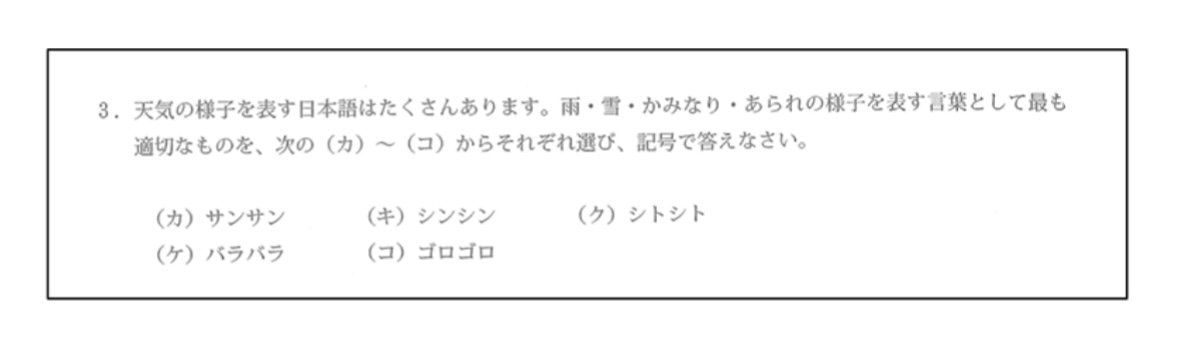
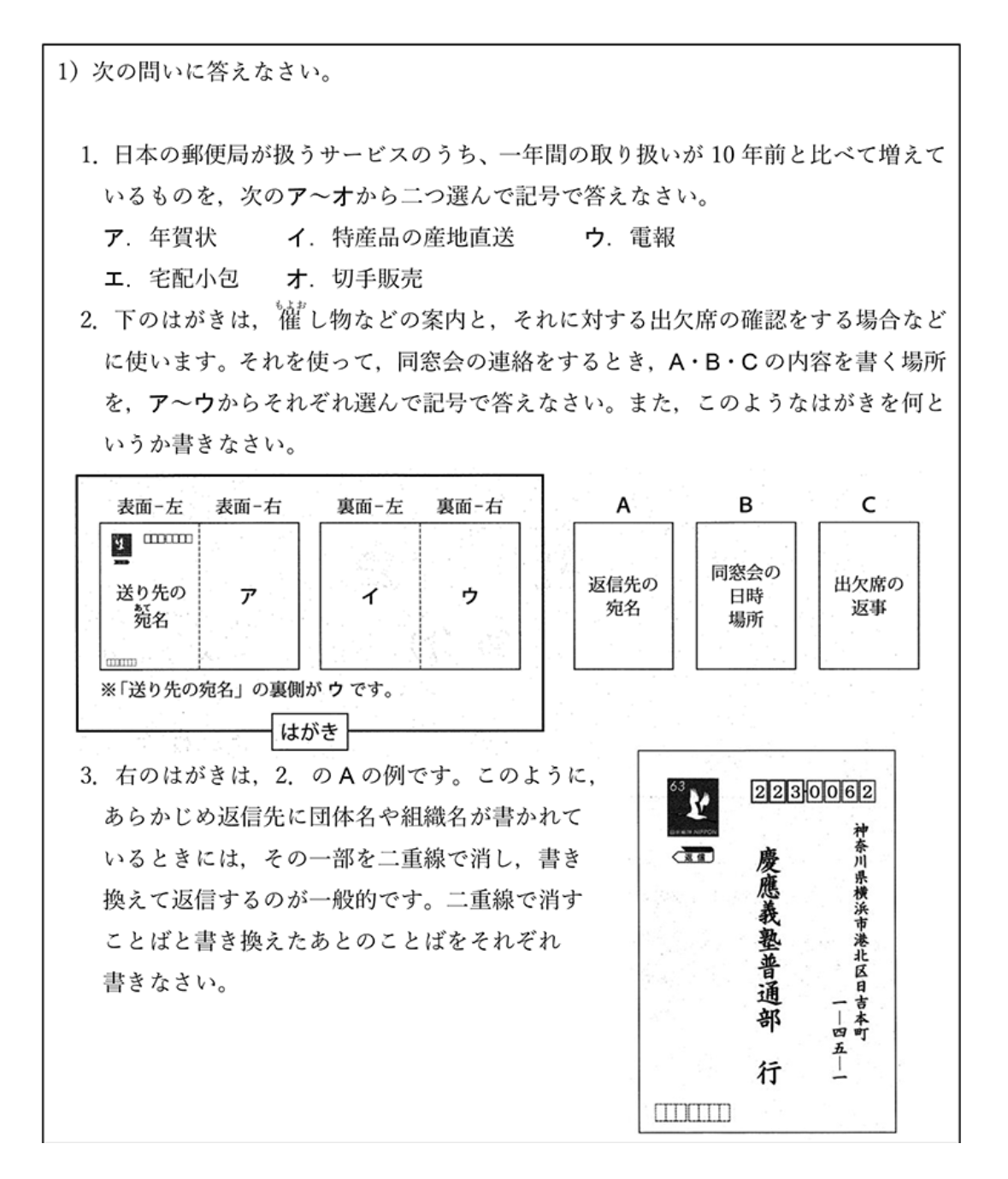
Pictured are some of the questions from Keio JH's entrance exam. For an adult, they are not that difficult. If you have a lot of different experiences and have read books and been curious, you can solve them. (I could, at least.) For a 12-year-old, however, they must be staggeringly difficult.


Shinburyo
Note: This is a very rough translation of a Wikipedia entry on Shinburyō (振武寮). I will try to clean the text up and add more information/links later.
Shinburyo was a facility located within the Imperial Japanese Army's 6th Air Force Headquarters in what is now Chuo Ward, Fukuoka City, Fukuoka Prefecture, and was said to have housed surviving kamikaze pilots until their next sortie. . It was established by requisitioning the dormitory of Fukuoka Girls' High School (currently Fukuoka Jogakuin Junior and Senior High School), which was located across the road from Fukuoka Girls' High School (currently Fukuoka Prefectural Fukuoka Chuo High School), where the military headquarters was located. After the war, the Fukuoka City Kyuden Memorial Gymnasium was built at the location, but it closed on March 31, 2019. It was managed by several air staff members from the headquarters of the 6th Air Force (commander was Lieutenant General Michihiro Sugawara), one of whom is said to be Major Kiyotada Kurasawa. Although it remained unknown for a long time after the war, its existence was revealed after the movie “Summer of Moonlight'' was shown in 1993.
There are also kamikaze members who went out as kamikaze members of the Shinbutai (the name of the special attack unit under the command of the 6th Air Force located in western Japan), but for some reason returned to their base without being able to attack, It is said to be a facility where special attack pilots who were unable to deploy for various reasons were kept until their next deployment. There are various factors, including external factors such as bad weather, engine trouble, equipment trouble, and attacks by enemy aircraft, as well as psychological fear of death and the fact that soldiers turn back because they expect a certain outcome and feel sorry for the death of a dog. There were even internal factors such as . . .. In particular, during Operation Tengo during the Battle of Okinawa, when the crew members who went on a kamikaze sortie did not attack and returned home, some of them were labeled as ``cowards who feared death'' or ``intentionally boarded the aircraft.'' They were accused of returning home with damaged equipment, and are said to have been subjected to discriminatory treatment.
Furthermore, the existence of similar facilities in the Imperial Navy Air Corps is not known. However, in the Imperial Army Air Corps, on November 7, 1944, which was the first sortie of the Army's air special attack unit, five modified special attack aircraft (and model number) of the Type 4 heavy bomber “Hiryu” of the “Futake Corps” were deployed. Four of the aircraft failed to engage the enemy and returned home, and the remaining four aircraft sortied the next day and all returned. Some of them were unable to engage the enemy from the very beginning of the kamikaze attack, and due to weather problems, a large percentage of the kamikaze aircraft returned. Recognizing this, for example, it was also used in the textbook “Togo Air Duty Essentials”, which was compiled by the Shimoshizu Flying Unit in May 1945 for the education of kamikaze pilots before the Battle of Okinawa. It was assumed that the kamikaze aircraft would return for unavoidable reasons, such as the specific procedures and guidelines for the return of kamikaze pilots. In addition, articles such as the Asahi Shimbun have also covered the returnees due to equipment failure, and there were no restrictions on reporting or concealment from the public.
According to the “Shinbutai Formation Table” prepared by the 6th Air Force, which was kept by Major Kurasawa, 605 of the 1,276 suicide bombers listed remained on standby or returned after sortieing. Of these, 9 in 21 Shinbutai, 5 in 22 Shinbutai, 6 in 30 Shinbutai, 4 in 38 Shinbutai, 7 in 65 Shinbutai, 5 in 67 Shinbutai, 2 in 76 Shinbutai, In the notes section of a total of 40 members, 1 in the 111th Shinbutai and 1 in the 112nd Shinbutai, there are entries that appear to be handwritten by General Staff Kurasawa “in Fukuoka” (however, there are entries about the Second Army Hospital in Fukuoka, etc.) It is said that this means that they were sent to the 6th Air Force headquarters, but Shinbu-ryo only existed for about a month and a half from May to June 1945, and the special attack personnel who were housed there were There were approximately 50 to 80 people [9] to 80 people, accounting for around 10% of the returned crew members.[10] The official records of the Imperial Army contain no mention of Shinbu-ryo.
There is no mention of this in the diary written by Lieutenant General Sugawara, commander of the 6th Air Force. It doesn't exist. The kamikaze soldiers were hidden in a room called the “sewing room” and “Omorikan”, an inn in front of Hakata Station that was used as a military inn for the kamikaze members who were on standby, but it was full, so they simply used the Fukuoka Jogakuin dormitory that had been taken over by the 6th Air Force, and were not forced to house them.” No. Major Hiroshi Kawamoto, who was on the staff of the 6th Air Force (and became the last mayor of Taniyama City, Kagoshima Prefecture after the war), also testified that there was a place in Fukuoka where kamikaze pilots with physical and mental disabilities could be given a “rest”. The leaders of the 6th Air Force either testified that they were not aware of the existence of “Shinburyo”' or denied it. On the other hand, some of the details have been revealed through the testimonies of the Kamikaze pilots who were detained.
However, the name “Shinburyo” refers to the air service quarters at Hofu Air Base in Hofu City, Yamaguchi Prefecture (located near Mitajiri Station). It was revealed in the will written by Second Lieutenant Sai Hamada of the 179th Shinbutai to his parents that the 179th Shinbutai 2nd Lieutenant Sai Hamada had also called them “Shinbudyo”. It has been pointed out that “Shinbutai” was simply a general term for the dormitory where members of the “Shinbutai” stayed, and Kurasawa also said, “Since all Okinawa kamikaze troopers are Shinbutai, they (the kamikaze members) can do whatever they like. I think it was called Shinbu-ryo.”
Incidentally, there are scattered cases in various places where the military gave their own names to private inns such as “Kokuryo”, “Hakkoso”, and “Hiryoso” when renting private inns to accommodate aviation personnel. The name is not a special case. Reasons such as loss of aircraft (Personnel and equipment are supplied from the formation unit to the frontline units in the form of increased allocation, so it is difficult for junior officers and non-commissioned officers who lose the aircraft to procure replacement equipment on their own) The reason why the returning members headed to Fukuoka, where the headquarters was located, was that the Shinbutai units were under the direct control of the 6th Air Force headquarters (in terms of operational organization, they were directed to local flying units such as the 6th Squadron). It is necessary to look at this point from an unbiased perspective, as it is completely natural if it is considered as a quarters for airborne personnel attached to the Air Force.
Survival Japanese


Usui
Usui 雨水 Yǔshuǐ (19 February ~ 5 March)
According to the traditional Chinese calendar, which divides the year into 24 solar terms (jieqi, 節氣 in traditional Chinese; sekki, 節気, in Japanese), Usui (雨水, Yǔshuǐ in Chinese) is the second mini season of the year. Lasting from roughly February 19th to March 5th, Usui means “rain water”. It is the time when the first day of spring has passed and we begin preparing for the arrival of full-fledged spring. Falling snow becomes rain, and the snow and ice that have accumulated over the past several weeks melt and turn into water.
Kasumi 霞
The phenomenon in which distant objects appear blurry due to water vapor in the air and the faint cloud-like appearance that appears at this time is called kasumi, or “haze”.
Although similar to fog (霧, kiri), it is usually called kasumi in spring rather than kiri, which is the term usually reserved for the mist that occurs in autumn.
春なれや
名もなき山の
薄霞
Harunare ya
Namonaki yama no
Usugasumi
“Spring and the thin haze of a nameless mountain”
This is a haiku by Matsuo Basho (1644-1694), the famous haiku poet from the early Edo period. Looking at the thin mist that hangs over the nameless mountain, you can see that spring is in the air.
The ethereal haze hanging over the foothills of mountains and lakes can sometimes appear otherworldly, magical.

Nekoyanagi 猫柳
The Pussy willow is a deciduous shrub belonging to the Salicaceae family, which produces dense silvery-white hairy flower spikes in early spring.The flower spike of the pussy willow resembles a cat's fur, which is—no surprise—how it got its name.
Known as neko yanagi in Japanese (猫柳, lit. “cat willow”), the plant is also called senryu (川柳, lit. “river willow”) because it often grows alongside rivers.
The haiku poet Seishi Yamaguchi (1901-1994) wrote the following poem.
猫柳
高嶺は雪を
あらたにす
Nekoyanagi
Takane wa yuki o
arata ni su
“Takane Nekoyanagi renews the snow”
The silver-white fur of the nearby pussy willow shines, and perhaps the high mountains in the distance are covered in fresh snow and shine brightly. This haiku conveys the signs of spring and the harshness of the cold weather that tightens the body.
Are Kinome and Konome the same?
Although written with the same kanji, 木の芽, konome refers to the buds of trees in general. Read kinome, it refers only to the buds of Japanese pepper (山椒, sanshō).
In recent years, the two are often used interchangeably, but in the past they were used separately.

Is “Doll’s Festival” an event for girls?
March 3rd is the well-known as the Doll's Festival, or Hina Matsuri (ひな祭り). It is also called Joshi no Sekku (女子の節句)
In ancient China, there was a custom to purify oneself in the river on the Day of the Snake in early March. This is known as Jōshi no Sekku, ( 上巳の節句) and is believed to be the root of Hinamatsuri.
It is said that this festival was introduced to Japan during the Nara Period. Over time, Japanese began transferring their impurity to dolls made of paper or straw and then sending them adrift in a river (流し雛).
As time passed, these dolls began to be displayed on doll stands, and the festival evolved into the Doll's Festival.
March in the lunar calendar is also the season when peaches begin to bloom, which is why the other name Momo no Sekku (桃の節句, Peach Festival) was born.
Today, the Doll's Festival is as an event to pray for the healthy growth of girls. Until the Muromachi Period, however, it was a festival to pray for the health and safety of not only girls but also boys and adults.
Translated and abridged from Weather News.

Blue Bottle
Blue Bottle Coffee has opened their first outlet in Kyushu to great fanfare. On a pre-open event, the beautiful "influencers" were brought in to do their magic. A following day, the cafe was packed and a long line of customers snaked out the front door like poop out of a guppy's ass.
So odd, I thought. The hype.
Yes, Blue Bottle has good coffee. Not great, but good enough. That's really all a legal narcotic needs to be. Good enough. But what it may lack in flavor, it more than makes up for in shop design and location. I've been to half a dozen BBs from San Francisco to Tokyo to Kyoto and all of them are gorgeous. The ones in Kyoto, in particular, are worth visiting.
The shop in an old house in the Higashiyama District is my favorite. The first time I went, I just gawked and gawked. How on earth did a little coffee chain from Oakland go from having about three outlets to so many in Japan, I wondered.
I gnawed on this mystery like a chunk of old beef jerky for a while. Was this just another start-up gone bonkers thanks to venture capitalists throwing money at it? I've seen that kind of thing a lot. Go to a supermarket and you'll find a new brand of, say, potato chips you've never heard of before and behind it is a get-rich-quick scheme of sorts. But Blue Bottle seemed different. Something or someone had to be behind it.
Well, I spat that hunk of beef jerky out and snooped around the Internet until I found the answer: Nestle. In 2015, Fidelity Investments poured $70 million clams into the company. That same year, they opened their first outlet in Japan. It was sold as a case of gyaku-yunyu (reverse importing) as Blue Bottle was bringing back the hand-poured and siphon coffee making techniques that were inspired by traditional coffee shops in Japan.
Then in 2017, Nestle bought a majority stake (about 70%) in the coffee chain and then started opening up outlets in other Asian countries. And now things don't seem so mysterious to me anymore. All those gorgeous influencers and sheeple were lining up for Nescafe.
At least the shop designs are cool.

At the Blue Bottle in San Francisco’s Embarcadero in 2001.

Private Schools
What percent of junior high school students go to private schools?
Nationwide, about 8% do, but at the prefectural level there is a big difference. In Tokyo, over 25% of students go to private junior high schools. Here in Fukuoka, only 6% do. In the prefectures of northeastern Japan, less than 2% attend private schools. The prefecture with the lowest private junior high school attendance rate is Yamagata at 1.4%.
https://todo-ran.com/t/kiji/15306


Love Hotels
Hard to believe that Fukuoka has a less than average number of love hotels. Shame on us.
The number of love hotels nationwide is (or was at the time of the original post) 5,670, or 5.39 hotels per 100,000 adults.
Miyazaki Prefecture has the highest number, with 14.08 per 100,000 adults (deviation value: 72.4). Second place was Saga Prefecture with 13.28 houses. From here on, to be known as “Saucy Saga”. Third place and below are Fukushima prefecture (12.50), Kumamoto (12.21), and Tottori (11.70). Begs the question what is going on in randy old Kyushu.
On the other hand, Hyogo Prefecture has the lowest number of hotels—only 0.84 per 100,000 adults (deviation value: 28.8). This is followed by Kanagawa (1.78), Aichi (2.70), Tokyo (2.73), and Saitama (3.35). Sad.
Incidentally, the very first rabuho I ever went to happened to be in Kumamoto. It was called DINKS, a term I hadn't heard of before. I asked my girlfriend what it was supposed to mean and she replied matter-of-factly, "Dual-Income, No Kids". The poor girl’s English wasn’t very good, but for some reason she knew that term. It just rolled off her tongue like she had said it a hundred times before.
(By the way, "DINKWAD" means "Double income, no kids, with a dog". A lot of my friends are DINKWADs.)
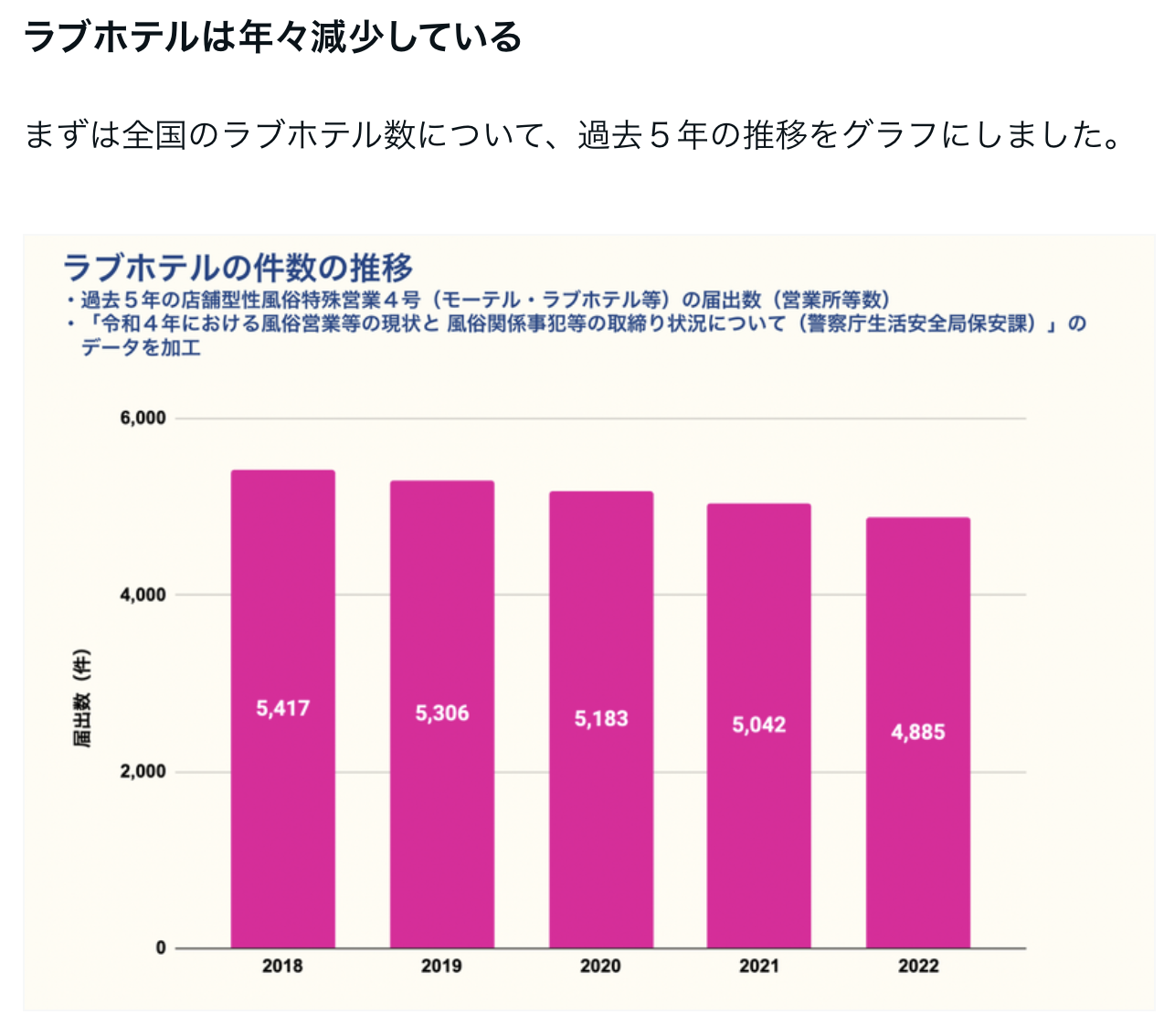
According the site note, the number of lover hotels has been gradually decreasing every year. In 2018, there were 5,417 establishments, but in 2022 the number had fallen to 4,885. It is estimated that around 100 love hotels go out of business every year. There seem to be a variety of factors contributing to this, including population declines in local cities, young people moving away from cars, and stricter regulations by local governments.


For more, go here.

Officer Friendly still exists in Japan
Heiwa Desu Ne
In the wee hours one morning in November, I was woken by the sound of a police car siren. Living downtown, disturbances in the middle of the night are not uncommon, but this night was different. The police car sounded as if it driving slowly up and down the streets around my building, siren blaring on and off.
Unable to sleep, I got out of bed to see what the commotion was all about.
I stepped out onto the balcony and looked down at the street below, but couldn't find anything amiss. But then came wail of the siren again. This time from the west and only a block away. I went to the living room and looked out the window in the direction the sound had come, but was still unable to see anything.
What on earth was going on? I wondered. The siren had sounded so close.
Ah, there it was again. This time, I hurried out the front door to get a better look. The siren was growing louder.
Standing on the stairwell and looking down the narrow road that passed the rear of my building, I discovered a young man on a bicycle. He was riding one of those electric bikes with the fat tires that look more like off-road motorcycles than your typical mamachari. He headed down the road in my direction. A patrol car, its lights flashing, came around the corner in leisurely pursuit.
Judging by the way the bicycle was weaving, the rider was slightly drunk. When he turned onto a wider road, the patrol car pulled up even with the cyclist.
"Please stop!" the police officer called politely over the PA system.
The patrol car then pulled ahead, attempting to cut the cyclist’s off.
"Please stop!"
Did the guy on the bike stop?
Nope, he just pedaled around the front of the police car, then turned down a narrow alley and continued on his merry way. With its lights flashing, the patrol car sped down the road and was about to turn off onto a side road but ended up getting blocked by a taxi.
I have no idea what happened after that, but judging by the silence, the drunk cyclist probably managed to slip away.
I couldn’t help but chuckle.
As long as I have lived here—thirty years and counting—the Japanese have been wringing their hands and fretting about the alarming trends the see on daytime wide shows and in the evening news. Perhaps it’s just part of the national character. But, you know, from my perspective, things are pretty darn good here.
Despite how people may feel about crime, the police’s own statistics paint a very different picture: “the total number of known cases of penal code offenses has decreased consistently since 2003. In 2021, the number was 568,104, the lowest since the end of the Second World War . . . In 2021, the rate of decrease was 7.5% over the previous year, which was lower than the level in 2020 when COVID-19 broke out.” (National Police Agency: “Crime Situation in 2021”)
Did the pandemic influence those numbers? Probably, but crime had already been on the decline since peaking in 2002. It was in the years leading up to 2002 that the “Dankai Juniors”, the cohort of Japanese born in the seventies were in their twenties and unemployment was over 5% — the Employment Ice Age (Shūshoku Hyōgaki), as it was known.
As for violent crime, why it’s so rare here that when it does on occasion happen, the more shocking cases tend to get ruminated on in nation's news shows for days if not weeks. On that sleepless morning back in November, America recorded its 500th mass shooting of the year. By comparison, there was only one shooting death in Japan in 2021. Murders, and violent crime in general, have fallen steadily since the sixties. There were 213 murders that same year, compared to over 21,000 in America. I know, apples and oranges. Then, consider England and Wales which has a population about half that of Japan’s and fairly strict gun laws. In the 2022/23 reporting year, 602 homicides were recorded, down from 697 in the previous year.
You don’t see homeless people camped out on the streets like I did all over California last spring. LA alone has some 50,000 people sleeping rough and over half a million (582,000) nationwide. In the UK, there are 365,000 homeless; in Germany, 263,000; and in Canada, 235,000. Among Japan’s neighbors, China has over 2.5 million homeless; Korea, over 11,000. In Japan, there are only 3,065, down 11.1% from last year. My adopted home of Fukuoka prefecture has just over 213 homeless, but you’d be hard pressed to actually spot any of them.
Although marijuana use among university “American football” players has been a hot topic in the news since last summer, the fact remains that drugs haven’t really been a serious problem in Japan since the end of WWII. There were, for instance, only a handful of arrests (3) in the most recent data related to heroin. Compare that to the opioid crisis in the US which has claimed over 645,000 lives due to overdoses and, well, there just is no comparison.
And because it’s so safe, stores in Japan needn’t worry about getting cleaned out by shoplifters or opportunistic rioters like they do in the US and last September in France. Cars rarely get stolen. (Bicycles, do, but if you report it to the police, they might find it in a few months just like they found my son’s bike, god bless ‘em.) Homes seldom get broken into. But, when they do, the culprits are usually found, occasionally perp-walked on national TV, then prosecuted and punished fairly swiftly.
No, Japan has the kinds of problems other nations wish they had.
Stepping back into my apartment, I discovered my wife at the genkan.
What happened, she asked sleepily. When I told her about the drunk cyclist playing cat and mouse with a patrol car, she laughed and said, “Nihon wa heiwa desu ne.” Japan’s a peaceful country, isn’t it.
“Ain’ it?”
And with that, I went back to bed and fell fast asleep.
Kotatsu Envy
What percent of homes have a kotatsu?

Ranking of those who "dream" of having a kotatsu.
1位 沖縄 (Okinawa) 63%
2位 北海道 (Hokkaidō) 60%
3位 東京 (Tōkyō) 53%
4位 神奈川 (Kanagawa) 50%
5位 愛知 (Aichi) 48%
No. 1 is easy to understand. In Okinawa, it never gets cold enough to need one. When we were shivering in freezing weather with a windchill of -4℃ a few days ago, it was about 20℃ in Naha.
No.2 Hokkaidō is interesting. Why would they long to have a kotatsu? Well, the reason is because they don’t need really them. For starters, homes and apartments in the northernmost prefecture are built for the local climate—i.e. better insulation, double-glazed windows, etc.. What’s more, heating is subsidized. (Need to fact check that.) My wife, who used to spend her winter breaks near Sapporo every year, remarked that even the room the toilet was in was always nice and toasty.
Meanwhile here in Fukuoka, I’m wearing my “longjohns”, have got the heater and electric carpet on high and I’m still cold.

Popularization of the Washlet
Ah, 1992. Aye, those were hard times when only 20% of homes had toilet that lovingly squirted your fanny with warm water. Japanese kids today don't know how easy they've got it.
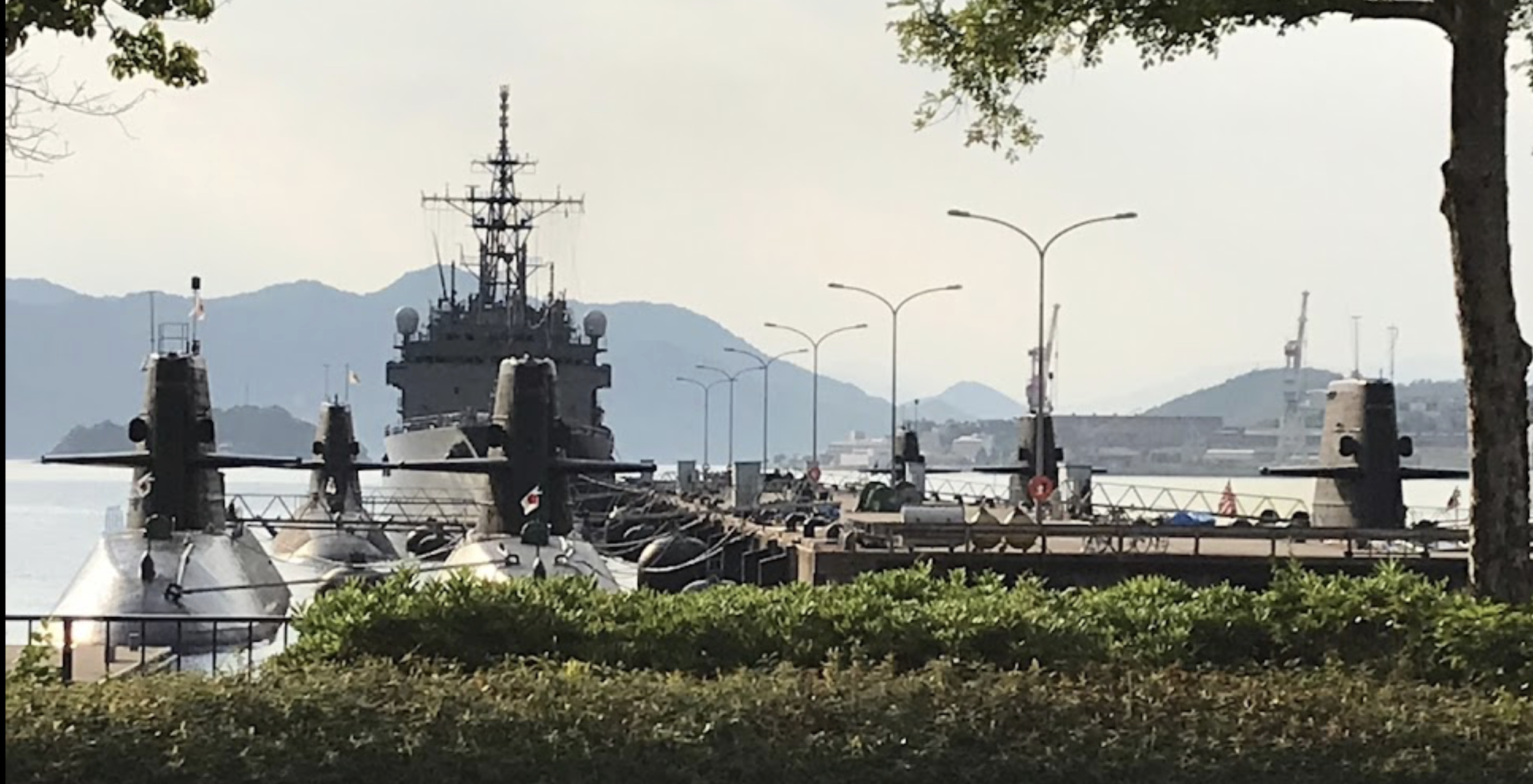
How Many Subs Does Japan have?
Just how many subs does Japan--a country that technically does not maintain military forces--actually possess?
"Article 9. Aspiring sincerely to an international peace based on justice and order, the Japanese people forever renounce war as a sovereign right of the nation and the threat or use of force as means of settling international disputes.
"In order to accomplish the aim of the preceding paragraph, land, sea, and air forces, as well as other war potential, will never be maintained."
Oh, never mind about that.


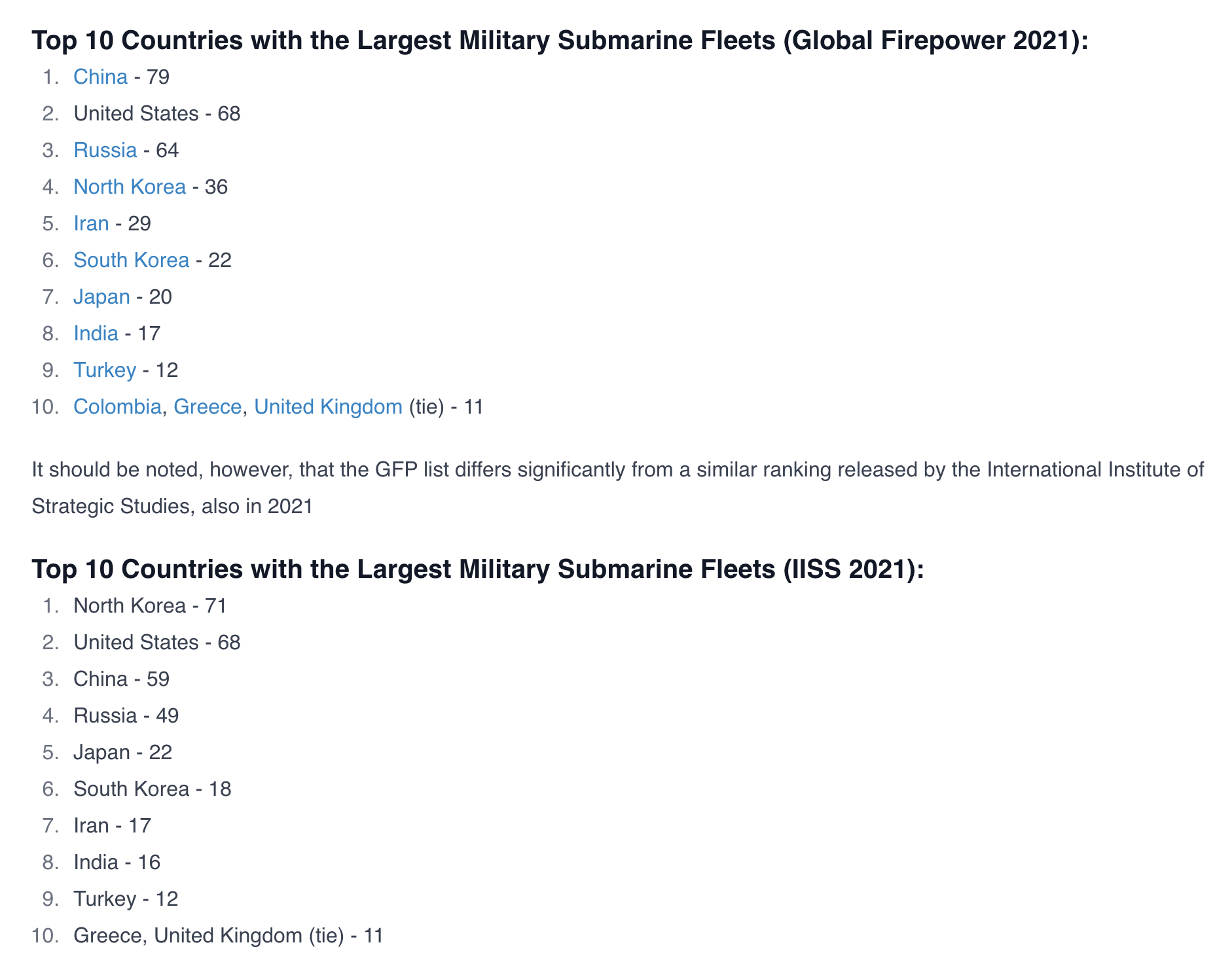

For some perspective, Japan started the Pacific War with 63 ocean-going submarines (i.e., not including midgets), and finished construction on an additional 111 during the war, for a total of 174. Three-quarters of these (128 boats) were lost during the conflict, a proportion of loss similar that experienced by Germany's U-Boats. For more go here.

Internecine Strife
Been dying for some northern African food, such as couscous, and have been meaning to make it myself if only I could find an easy recipe and ingredients. Well, yesterday, my wife came back from the supermarket with this retort set.
Starving, I threw it together, added extra cumin and black pepper and dug in.
For a retort-packed meal it was alright. Better than nothing and good inspiration to finally get off me arse and make the real thing.
Six hours later, though, I started feeling funny in my tummy. A small burp came up—cumin, chicken, and chickpeas.
Uh oh.
More burps.
This ain’t good.
Then my stomach started to hurt. Not too bad, but constant. I took some bioferomin, drank some water and went to bed to try and sleep it off.
Thing is I couldn’t sleep.
The box said the food had been made in Tunisia, packed in Japan. Tunisia. It was one of the few countries that managed to escape the instability and violence of the Arab Spring, if memory served me correctly. But it now felt like there was a coup d’état going on in my stomach.
After several hours tossing and turning, I got up, sat on the toilet and contemplated options. If I lie down I’ll probably chuck Tunisia up, her peace-loving citizens and all.
I got some yogurt, ate that, then sat down on the sofa and tried to keep my mind off of things.
When my wife found me, she asked what was the wrong. The cous cous, I said.
"Are you going to vomit?"
Don’t say that word!
"The other day when we had Chinese, I felt sick, too. I made myself throw it all up and . . ."
Stop talking!
"Just stick your finger in your throat and tickle . . ."
WOMAN!!! Leave me alone!
"Suit yourself."
I managed to fall asleep on the sofa, but woke up in a cold sweat an hour later. Sat on the toilet again, ruminating. I should have vomited Tunisia up hours ago. If I had listened to my wife, I’d be out of the woods by now, sound asleep in bed. Too late now, though: internecine skirmishes were already moving south
Don't know about you, but I can count the number of times I have vomited in my life: six. I just don’t spew cookies like others do. Even after eating Tunisian food that had gone bad.
And so, I went back to the sofa and fell asleep. Three hours later I woke up feeling fine. The struggle was over. Peace had been restored. But I vowed: NEVER again would I eat a retort meal from a northern African nation.
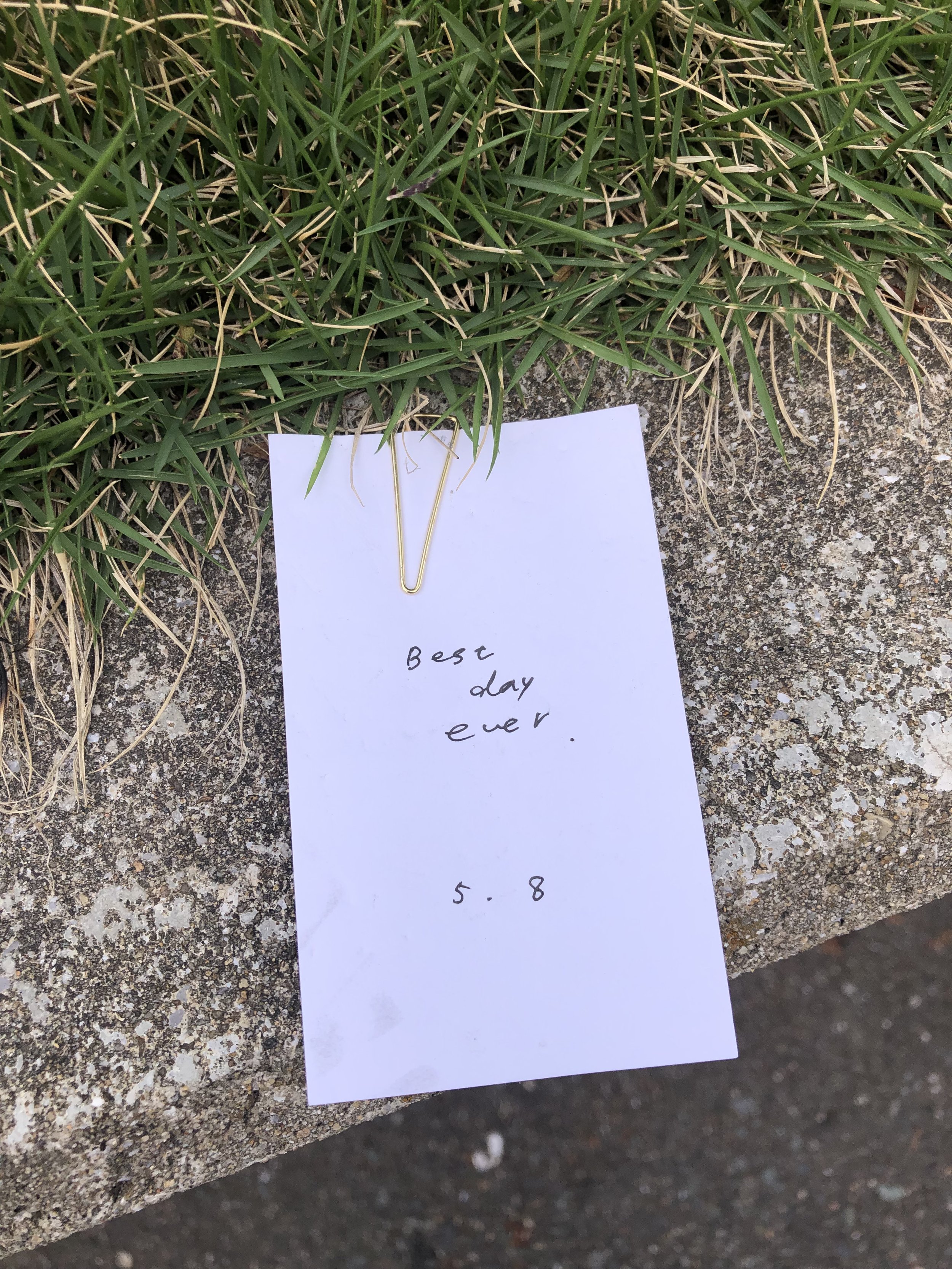
Best Day EVER
I find this in my neighborhood.
In the park.
Close to where all the love hotels are.
I picture a foreign man with a Japanese woman, both young and relatively good looking, leaving one of those hotels, slightly uncomfortable, yet holding hands. They walk to the nearby park where they hug one last time. The man takes out his card, writes this message on the back, and gives it to the girl before kissing her goodbye.
Now that he is gone, she turns to head home. It’s a long walk and she’s cursing herself for having missed the last train. The least he could have done was offer me money for a taxi, she thinks. Would she have accepted it, though? No, she wouldn’t have. She pauses, looks at the card. “Best day ever?” she asks herself. “Meh,” she answers and tosses it to the ground.

Language of Love and Hate
When learning a foreign language, and particularly when you're fully immersed in it, you may come to associate words with the places where the words were first learnt, or with the person who first taught you them. As the years pass and your circle of acquaintances or, in my case, roster of former lovers grow, you may start to notice that the mood or nature of a relationship can be characterized by the words that were acquired during the time when those people were in your life.
A rocky relationship with one woman taught me the words ayashii (怪しい, questionable, dubious, fishy, suspicious, unreliable), yabai (ヤバい, chancy, dodgy, touch-and-go, in hot water), and so on.
My first marriage was wellspring of words such as iyami otoko (嫌み男, sarcastic bastard), dasan-teki(打算的, calculating), sekoi yatsu (stingy bastard), and yôryô ga warui (要領がわるい, cack-handed). I also learned the word 慰謝料 (isharyô, “consolation money”, a.k.a. alimony) from that woman. Ah, the memories!
Less contentious lovers have taught me, among other things, toriko (虜, a slave to love), horeru (惚れる, be entranced, be taken with), and zokkon (ゾッコン, to be head over heels). Sigh.
For someone like me who enjoys reading and writing, who hungers for new words and vocabulary, to be in the company of someone who is a source for fresh vocabulary or novel ways of saying what has long become tiresome and clichéd can be as stimulating as the sex itself. Almost.