
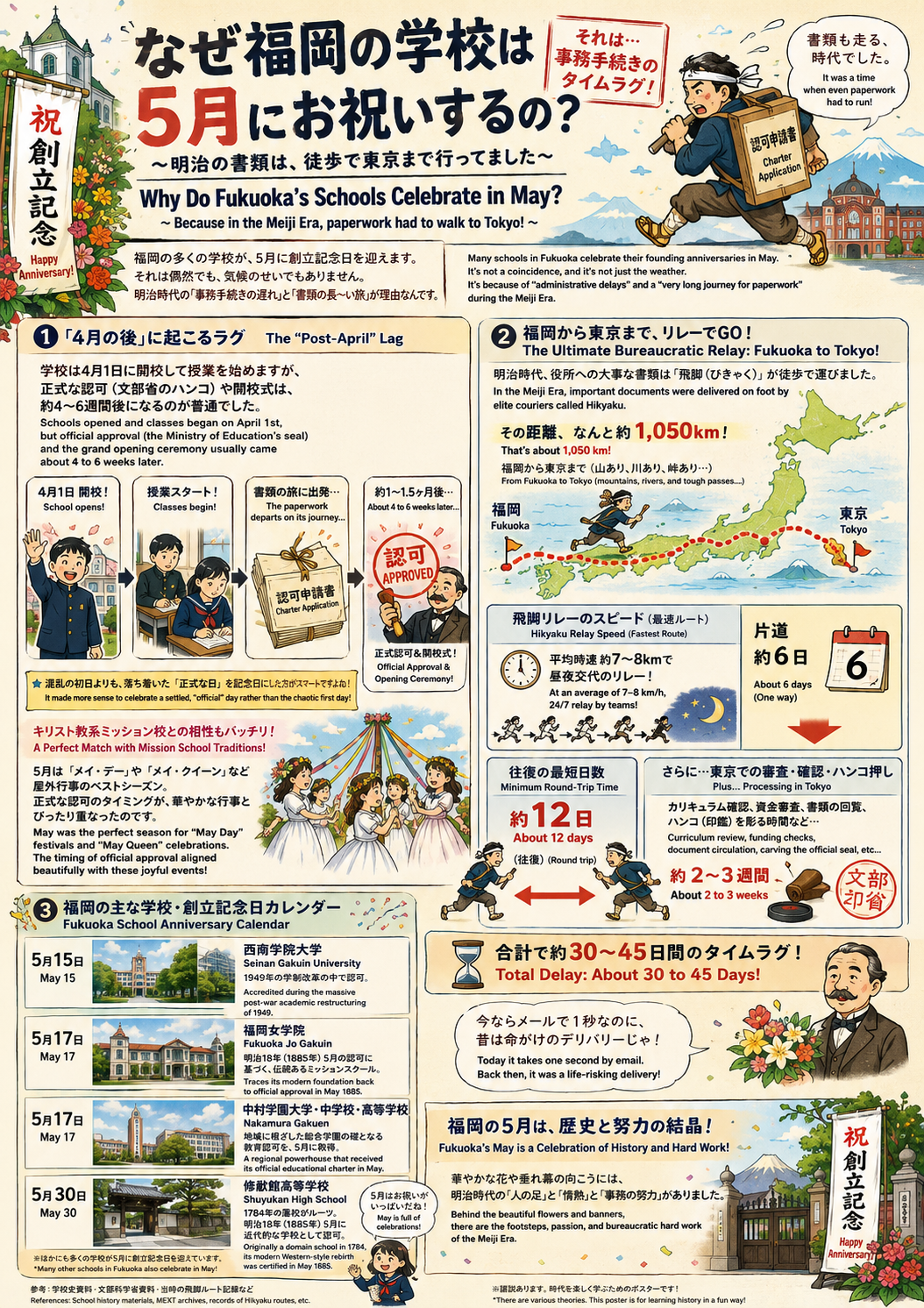
Exploring the history, administrative lag, and the grueling 1,000km charter run of the Meiji Era
If you walk through the streets of Nishijin or Sawara this week, you’ll notice something vibrant in the air. It’s not just the scent of early summer—it’s the sight of flower stands, festive banners, and students in crisp new uniforms. In Fukuoka, May isn't just a month; it’s Anniversary Season.
From the historic gates of Shuyukan to the sprawling campuses of Seinan Gakuin and Nakamura Gakuen, a massive cluster of Fukuoka’s most prestigious institutions hold their founding celebrations in May. While culture and weather play a role, the core explanation comes down to an intriguing bureaucratic phenomenon: The Post-April Administrative Delay.
1. The Mechanics of the "Post-April" Lag
Since 1886, Japan’s fiscal and academic calendars have strictly kicked off on April 1st. Naturally, you would expect a school's anniversary to land on its first day of classes. However, in the Meiji (1868–1912) and early Showa (1926–1989) eras, opening a school was an administrative labyrinth.
A school would open its doors, admit its inaugural class, and begin instruction in April. But the official government charter, the final legal stamps from the Ministry of Education in Tokyo, and the scheduling of a grand opening ceremony routinely dragged out for four to six weeks. Rather than celebrating the chaotic first day of school, institutions permanently anchored their "Founding Days" to the day the official paperwork was finalized and the campus had finally settled into its routine—pushing the celebrations directly into mid-to-late May.
The "Missionary Belt" Synergy
This administrative lag perfectly aligned with the Western cultural traditions of local Christian mission schools. For institutions like Fukuoka Jo Gakuin, May was the prime
time for "May Day" festivals. The arrival of the formal charter matched perfectly with outdoor pageants, Maypole dancing, and the crowning of the "May Queen."
2. The Ultimate Bureaucratic Relay: From Fukuoka to Tokyo
To truly appreciate this delay, we have to look at the physical reality of governance in early modern Japan. Before the telegraph and the rail networks completely bound the nation together, official documents had to travel by foot. If a Fukuoka school needed its charter approved by the central government in Tokyo (formerly Edo), it relied on the elite courier system known as Hikyaku (飛脚).
The overland route via the historic Sanyodo and Tokaido highways spans roughly D ≈ 1,050 ext{ km} (approx. 650 miles). How long did this monumental legal errand take?
The Physics of a Meiji Paperwork Run
Ordinary travelers typically required about 30 days to walk from Fukuoka to Tokyo. However, an elite, multi-stage relay system of professional runners (Tsugi-hikyaku) could sustain a punishing, around-the-clock pace.
Operating at an average speed of v ≈ 7 ext{ to } 8 ext{ km/h} across rugged mountain passes and river crossings, a dedicated express relay could complete a one-way trip in approximately 6 days.
Therefore, the minimum theoretical transit time for a charter's round trip was:
T_{ ext{transit}} = 6 ext{ days (Express Out)} + 6 ext{ days (Express Back)} = 12 ext{ days}
When you factor in standard bureaucratic processing time within the Tokyo ministries—reviewing curricula, verifying funding, and physically carving and applying the official seals—an additional 2 to 3 weeks was easily added to the timeline. When accounting for this intense 12-day physical journey across Honshu and the subsequent bureaucratic gears grinding in Tokyo, a 30-to-45-day delay between a school's actual April opening and its official May charter becomes remarkably impressive for the era.
The Fukuoka Anniversary Calendar
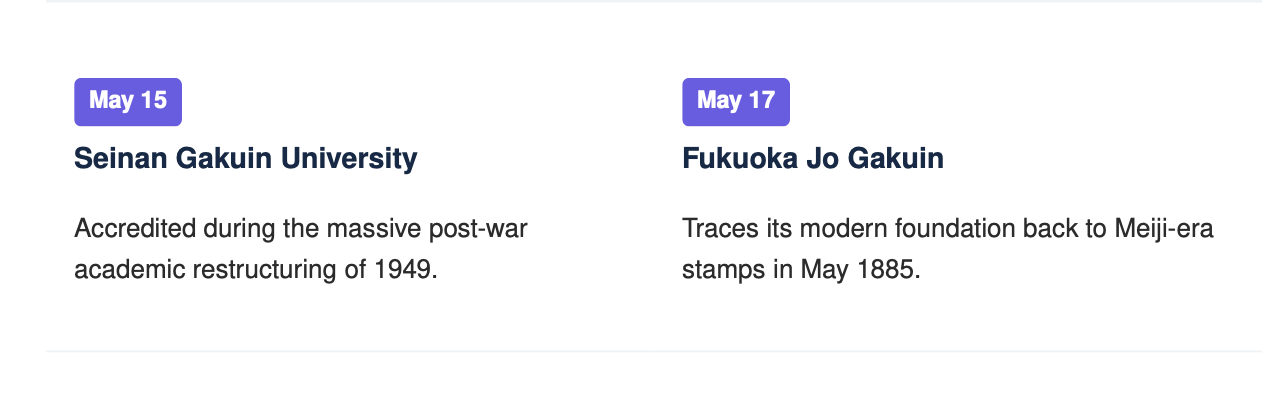
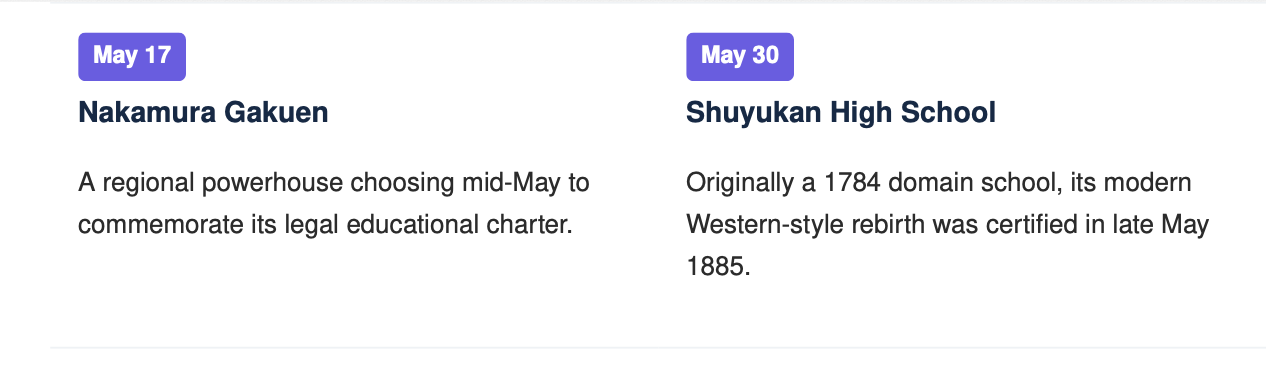
The next time you spot the massive floral arrangements and celebratory banners outside a school gate in Fukuoka this month, you aren't just looking at a modern school holiday. You are witnessing the beautiful intersection of Meiji-era logistics, grueling trans-Japan foot relays, and the enduring legacy of early bureaucracy.