
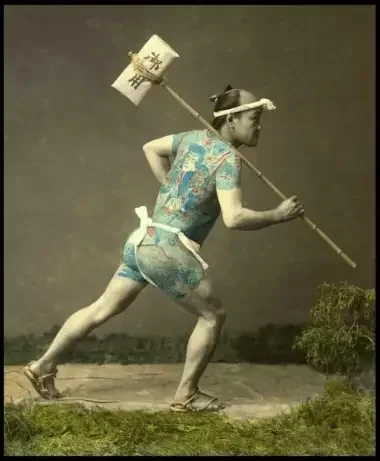
America had the Pony Express. In Japan they had the Hikyaku.
Imagine a feudal Japanese version of FedEx, but instead of delivery trucks, you have incredibly athletic men sprinting across the country in loincloths.
Those were the Hikyaku (飛脚), which literally translates to "flying legs." They were the backbone of Japan's communication and transport network during the Edo period (1603–1867), connecting the shogun's capital in Edo (modern-day Tokyo) with the imperial capital in Kyoto and the commercial hub of Osaka.
Here is a breakdown of how these legendary runners operated:
The System: Speed and Stamina
The Hikyaku didn't just run a marathon and call it a day; they operated on a highly efficient relay system.
The Relay Network: The main highway, the Tokaido, had 53 government-sanctioned post stations (shukuba). A runner would sprint at top speed from one station to the next, hand off the documents or package to a fresh runner, and the cycle would continue.
The Pace: While a normal traveler took about two weeks to walk from Edo to Kyoto, the fastest express Hikyaku could make the roughly 300-mile (490 km) journey in just 3 to 4 days. That means the network was moving at an average pace of around 75 to 100 miles per day, operating day and night.
The "Uniform" and Gear
If you saw a Hikyaku coming, you knew it. They traveled incredibly light to maximize speed:
Minimal Clothing: They typically wore only a fundoshi (loincloth) and straw sandals (waraji). Because they wore so little, many Hikyaku sported elaborate, full-body tattoos (irezumi) featuring dragons, deities, or koi fish, which served as a sort of artistic "clothing" and showed off their masculine pride.
The Mail Stick: They carried a bamboo pole over their shoulder. Attached to the front was a small box or packet containing the letters, and attached to the back was a small bundle of spare sandals, since running on rough roads tore through straw footwear rapidly.
The Bells: They often attached bells to their poles. The jingling cleared a path through crowds and signaled the next relay station that a runner was incoming, allowing the next guy to prep and start running before the handoff even occurred.