• Work
  • About
Menu

Aonghas Crowe

  • Work
  • About
DSC04547.jpg
stay-alive-game-1.jpg

I'm the Sole Survivor

June 2, 2021

The kids are now in their second week of school after Golden Week, which is always a tough time for any student here. Gogatsu-byō, they call it. (Lit. May Disease, but can be translated as post-vacation blues.)

One of the kids in my elder son's class has stopped coming to school altogether, much to my son's delight. (The two go to the same dojo and have hated each other since kindergarten.) The kid hadn't been doing his homework (of which there is a pile every day) and was doing poorly on the tests. (This is all hearsay, so I can't really verify.)

Seems kids like to push buttons at the start of the year to see how much they can get away with and my sons, because of the way they look (i.e. not Japanese) tend to get picked on first, which is one of the reasons I had them take karate from such an early age. One kid made fun of my elder son's name, so he went up to him, stared him down, and in his deep voice--a la Robert De Niro--said something like, "You talking to me?" And that was the end of that. He can break baseball bats with one kick and the other kids know it, so he is able to manage these little pests fairly easily.

My younger son is more the lover than the fighter type, slightly more sensitive than his big brother, but still scrappy. He said that one of the kids called him "Amelika-jin". Now, I'm not the rah-rah U! S! A! meathead type, but this kind of thing just pisses me off, especially when you consider history, geopolitics and so on.

When my son told me about it later, I told him that the next time some idiot says something like that, say: "Hey, twinkie, would rather be speaking Russian or Chinese?"

Fact of the matter: if it weren't for America--warts and all--Japan would be a very different country today.

My wife was listening and said, "You're Daddy's right. You boys are lucky to be American. Those passports alone, Do you know how much those are worth???"

I turned to my wife and said, "From now on, I would like you to greet me in the morning with 'Thank you, America!'"

And we laughed it off.

From experience, these little trials don't last very long. Again, it seems kids like to see how much they can get away with before the teacher steps in and puts a stop to it. We've been lucky with our teachers in that regard.

Yesterday, during our morning walk, I noted that our elder son's school load sure was ratcheted up since entering the fifth grade. He has I think 10 subjects now and all of them really demand a lot of the student. Math, which, is taught sometimes 6-8 times a week in the earlier grades to really make things sink in, is only taught 4 times now, but the content is much more difficult. The typical American high school student would probably be stumped. And that's just math. Then there's Japanese and even more Chinese characters to remember how to not only read, but write. Science and Social Studies are also vigorously taught, if you can say that. At any rate, they really take each and every subject dead serious.

We're fortunate, though. The boys, while they wouldn't mind having less homework every day, seem to be enjoying their studies and keeping up well enough.

I told my wife that education in Japan reminded me of a game I used to play as a kid called Stay Alive where the "sole survivor" is the one who manages to not lose his marbles and get into Tokyo University.


According to the missus, of the 400 students at Shuyukan, Fukuoka’s most competitive public high school, only one or two are able to get into Tokyo University, the country’s most prestigious uni. Only one to three graduates get into Kyōto University, Hitotsubashi, Ōsaka. Half of them, however, are able to enter Kyūshū University. Among the 400 students at Jōnan High, the second tier public high school, only one can pass Ōsaka or Kyōto University. 50 get into Kyūshū U.

It’s amazing how competitive places at those top universities are.

In Education, Family, Raising Kids in Japan Tags Gogatsubyo, May Disease, 五月病, Truancy
Comment
s-l1600.jpeg

Doggone It

June 2, 2021

There’s a parable in one of Kurt Vonnegut’s books about a craftsman of exquisite leather straps for horse buggies who was going out of business just as cars were becoming more common. Confused by the predicament he was in, he said something to the effect that it couldn’t be the quality of the straps he was making.

And so it is with writing books.

I’ve always wondered how many copies of an individual book was being sold whenever I heard the word “bestseller” or “bestselling” to describe it. Well, now I no longer need to wonder:

https://www.tckpublishing.com/amazon-book-sales-calculator/

Just type in the books rank, choose “book” or “ebook”, then click calculate, and you’ll know how many copies a book is currently selling. The site claims to have a degree of error of 6%, which they say is better than other calculators out there. All I can do is take their word for it.

Currently the No.1 bestselling book on amazon.com is Dr. Seuss’s Oh the Places You will Go. It has sold something like 80,000 copies this month alone, most likely by people who were shocked that some of his more “offensive” books would no longer be published. Lesson learned: all publicity is good publicity, but it doesn’t really help the writer all that much when he’s been dead for 30 years.

The first book in the YA fiction hit Magic Tree House series sells a hundred books a day. The series consists of about 50 books in total, plus non-fiction companion books, so Mary Pope Osborne, the authoress, is doing alright—maybe 100,000~150,000 books a month. Not bad at all.

Bad Feminist by Hatian-American intersectional lesbian feminist (enough boxes ticked there for ye?) sells about 25 copies a day on Amazon despite all the press and positive reviews she gets. Seems every reviewer out there wanted to say a good word about the book. Is it good? Dunno. I will say that it is certainly a sign of the times. If you want to get published by a major publisher then it doesn’t hurt being a minority queer. I can’t help but wonder if the readers are as excited about books like that as the publishers and reviewers are.

Trump’s ghostwritten The Fart o’ the Deal sells 5000 copies a month which isn’t bad considering how long ago it came out—1987.

My wife and children recently wrote to Nasu Masamoto, the author of a series of books for elementary school kids that was published from the late 70s to 2004. There are 50 volumes to the series which sold some 25,000,000 copies in Japan, Korea, and China. Recently, I’ve been asking my university students if they have heard of him or his books, but not a single one has. Amazing. In short, selling books is hard even with the wind in your sails, especially these days when people have their noses in their phones, their heads plugged into games and stupid videos.

According to another website, the average book in the US sells less than 200 copies per year, and less than 1000 books over its lifetime. A book has less than a 1% chance of being stocked in the average bookstore, especially if it is a book that is in a saturated genre.

I check out how my author friends were faring. The first novel by a friend published by an imprint of Harper’s is selling about one copy a month. Another friend’s highly promoted, highly reviewed, award-winning thriller published by Simon and Schuster sells about 5 ebooks a month on Amazon.

Pico Iyer, who doesn’t speak Japanese despite living here over a quarter of a century and whom many claim is an expert on Japan, but I have my doubts, sells about 80 copies of his Beginner’s Guide to Japan published by Vintage every month.

The book currently at 100 on Amazon’s bestselling list is a YouTube tie-up YA mystery that is selling about 9700 books a month. I have read or own 15 of those 100 books, many of which, like George Orwell’s 1984, are standards that are hard to bump out of the way on your pursuit of fame and fortune in writing.

In Writing Life
1 Comment
Unknown-1.jpeg

Michael Wolf

May 30, 2021

Photographer Micheal Wolf's "Architecture of Density"

https://photomichaelwolf.com/#architecture-of-densitiy/5

Unknown.jpeg
In Art, Photography Tags Architecture of Density, Micheal Wolf, Photography, Hong Kong
Comment
Host.1.jpeg

Where the Boys Are

May 24, 2021

CC Club, Japan's first "soapland" catering solely to women clientele, closed its doors in October of 2007 only eight short months after it opened.

The manager was reported to have said that the initial response to the club's opening exceeded expectation. "Women traveled from all over the country to visit us, but we couldn't establish enough repeat business with local women."

The service offered by CC Club was similar to that of ordinary soaplands: there was a private room with a bath and a bed, and women were provided with a "healing treatment" from the "soap boys".

CC Club charged ¥30,000 for the first ninety minutes and an additional ¥10,000 for every thirty minutes thereafter.

"It's what men generally have to pay at an upscale soapland," said the manager. "Shortly after opening we were inundated with calls from all over the country. Our homepage also got a lot of hits."

While most of the clientele were in their 30s, a wide range of women from their 20s to 50s patronized the establisment, many traveling from as far away as Ôsaka and Tôkyô.

The manager believes the failure of the club can be attributed to its location in the heart of Nakasu's red light district. Women living in Fukuoka may have been hesitant to visit it out of fear that they would be seen by someone they knew. "The main constituent of our client base was clearly women from outside of the prefecture. In the end, we had to abandon the business."

The women who frequented CC Club were more likely than men to seek emotional interaction with their soap boys in addition to sex, and if comfortable with a particular host they would continue to request that host in future visits. As a result, there was an inevitable backlog with popular hosts. Another problem was the limited number of women a host could "accomodate" in a single day.

To cope with the overwhelming demand for the more popular hosts, CC Club removed pictures of its soap boys from the club's homepage and limited the hosts to a maximum of three clients per day.

Soap boys, many of whom had to rely heavily on Viagra to be up for the task, reportedly called the work "a living hell" and were physically worn out by the end of their shifts.

CC Club, which has changed its name to Hitozuma (another man's wife) Club Lady Lady, reverted back to an ordinary soapland in November 2007 and now services male customers. 

In Dating, Humor, Oddball Tags Soap Land, Soap Boys, Brothel for Women, CC Club Fukuoka
Comment
unnamed.jpg

Okinawa Henkan

May 24, 2021

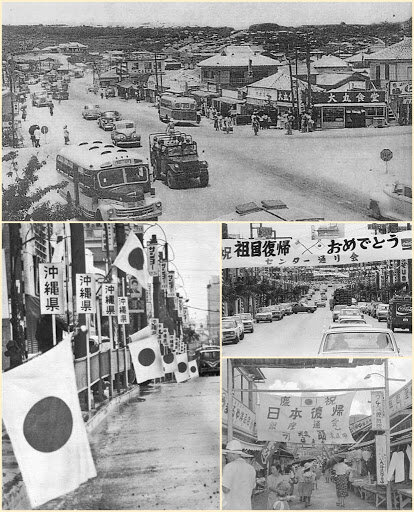
The US Civil Administration of the Ryukyu Islands ended on 14 May 1972 when the prefecture was "returned" to Japan the following day. Ryukyuan postage stamps and passports had been in use, and the dollar was the currency until then. Cars continued to drive on the right till 1978.

The return of Okinawa was never a foregone conclusion because the US used the islands as a bargaining chip--first with the Chinese in November of 1943 to keep Chiang Kai-shek from concluding a peace deal with Japan and keep them in the war, then with the Japanese to prevent her from concluding a peace treaty with the USSR. The US warned Japan that if they were to do so, America might keep the Ryukyus under US control forever.

Realpolitik is hard ball.

o1080066014758982266.jpg
Before switching to left-hand drive (L) and after the switch in 1978 (R).

Before switching to left-hand drive (L) and after the switch in 1978 (R).

In History, Japanese History, Japanese Politics Tags Okinawa History, WWII, Return of Okinawa, 沖縄返還
1 Comment
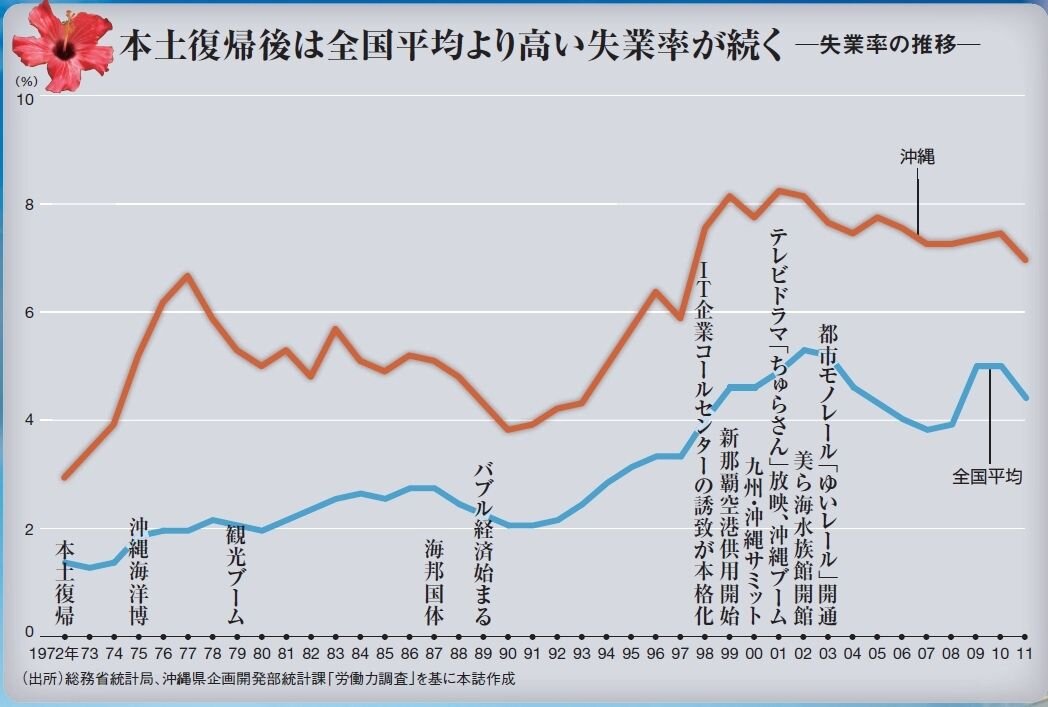
Unemployment rate in Okinawa since its return to Japan in 1972.

Unemployment rate in Okinawa since its return to Japan in 1972.

Unemployment in Okinawa

May 24, 2021

Shortly after becoming a prefecture again, unemployment in Okinawa more than doubled from 3% to almost 7%. The average rate in the Japan at the time was 2%. The Amami archipelago also experienced economic hardship when it was "returned" to Kagoshima prefecture in 1953 and was one reason Okinawa was originally cool to the idea of reunification with Naichi (mainland Japan). (I will expand upon this at a later date.)

During the '80s unemployment fell steadily, but rose sharply in the 90s after the asset bubble had burst. Despite a number of public works projects--a new airport in '99 (You should have seen the old one--yikes!), the Yui Rail monorail in Naha in 2003, highway E58 (“goya”) which has been built piecemeal over the past fifty years, the TV drama "Chura-san", which ushered in the "Okinawa Boom", unemployment has remained much higher than the nation's average.

Today, however, things have improved considerably. In December of 2020 unemployment stood at 2.9% nationally and only slightly higher at 3.4% in Okinawa. Among 15~29 year olds, the rate was 5.2% locally, compared to 4.5% nationwide. Mind you, that is during the Covid-19 pandemic which has hit the tourism industry hard.

Red line is Okinawa; blue, national average. R1 is 2019; R2, 2020.

Red line is Okinawa; blue, national average. R1 is 2019; R2, 2020.

I have been asked why unemployment shot up after the return of the islands to Japan.

I believe a lot of local Okinawans lost jobs they had on the bases. One site says that some 19,000 locals had been employed by the US government, which doesn't sound like a whole lot, but the population of Okinawa was only 970,000 at the time. The labor force at the time was 370,000 people. 20,000 amounts to about 5.5% of the labor force. There were also troop reductions which probably had further knock-on effects to the local economy. Unemployment rose for the whole country at the time, too.

The bases accounted for about 16% of the local economy in 1972. Today that figure is a healthier 5.3%.

In Japanese History, Economy Tags Okinawa, Unemployment in Japan, Unemployment in Okinawa, Public Works in Okinawa
Comment
Art work by Chris Woods

Art work by Chris Woods

A Burger By Any Other Name

May 16, 2021

Zooming with a woman this morning I noticed that just behind her was a Buddhist family altar. I told her that I had always wondered what her family’s religion was. I have known her mother for decades now and she always struck me as Protestant because of her interests and the things she had said over the years.

She explained that her mother was from a Shinto family and that the butsudan behind her was for her paternal grandparents. When her father went to Oxford to continue with his studies in physics, he brought the family, too. There they were exposed to Christianity for the first time. She herself would go on to ICU, a prominent Christian university in Tokyo, and later earned a master’s degree from an American university, during which time she lived with an Evangelical family. Over her years in America she attended service with them and grew to appreciate the warm, inviting mood of their religion, but was never interested in converting. It was the same with her mother.

In Japan you can’t really ask people about religion. I mean you can, but why open up a can of worms? Those who are willing to talk about it tend not to be religious. Those who are religious tend not to talk about it because, well, frankly a lot of the so-called “new religions” are secretive and cultish.

And so we went off on a long tangent about Christianity. She was still confused about all the different denominations.

Think of them as different brands of hamburger joints, I suggested. Roman Catholicism is the biggest, most established brand. No matter where you go in the world, you can buy a Big Mac or a McDonald’s burger that is made in the exact same way. Go to Sunday Mass in America, the Congo, or Japan and they will be doing the same thing, reading the same passages from the Bible, doing the same sacraments, and so on. Local dioceses will have a local menu, so to speak. In Japan they have the teriyaki burger, tsukimi burger, etc., but the Value Menu will be the same. The corporate headquarters in the Vatican decides it all, but gives some room to maneuver in the local market.

America is a free market of different franchises of burger joints, er, denominations, and do things their own way, but still serve hamburgers.

In the UK, they have a knock-off version of MickeyDee’s, and also sell the same versions of hamburgers, but the guy manning the griddle flipping burgers is sometimes a woman, and they can get married. They also haven’t adopted some of the corporate policy changes that were decided upon in the various Vatican Councils.

In the US, the Church of England is Burger King, but they now call themselves Anglicans or more often Episcopalians, which nobody really understands means, except that after the Revolutionary War being associated with England was a no-no.

She asked if I still went to McDonald’s.

I said that I had grown up on those burgers but lost my taste for them a long while ago. I still crave the familiarity of a Big Mac every now and then, and think my sons should at least try it to know what it’s all about, but every time I have a Big Mac, I think, why, God, did I do that to myself. That said, it’s part of the package, the identity of being “Irish Catholic”.

But then that’s the thing about growing up, becoming an adult: you have to unlearn the things your parents taught you and find new joints to dine in.

So, where do you go now, she asked.

Yoshinoya sometimes. Sometimes I pick up a rice ball at the local combini, and it’s soooo good.

The Baptists are like independently run burger joints, I continue, and just make shit up. Blue cheese on a hamburger? You gotta be kidding me. Yes, I like blue cheese, but never on a hamburger. That’s blasphemy.

Comment
MCHS1968.jpeg

Destine

May 16, 2021

This should do the trick.

Ten years ago I started really traveling Japan rather than just living here. On my first visit to Tokyo in a decade I happened to pass by a Uighur restaurant. It then occurred to me that if Tōkyō had Uighur, they might have Lebanese, too, and, hey presto, they did. As I drank an Almaza beer, I got a strong hankerin’ fer a narghile. Another GoogleMap search and I learned that there was a shisha cafe in a place I’d never heard of before called Shimokitazawa. So, I popped over there and, boy, what a discovery. I had been smoking at home on my own narghile for over five years, but had never come across any places that had it in Japan. The place in Shimokita was Japan’s very first and I would be dropping by there regularly over the next decade.

I quickly learned that that if I did a search of ‘“mizu tabako”, I’d find an interesting place with cool people, but not as cool as the ones I met in Shimokita. Still, cool ‘nuff.

An’ so, that’s how I found Jajouka in Kyōto and Destine in Ōsaka. Now, 10 years later, I am still coming. Staff have become friends in the meantime. Love this place!

Destiny!

In Life in Japan, Travel, Drinking Life Tags Destine, Osaka, Kansai, Shisha, 1 Bangai Cafe & Shisha, Narghile
Comment
Red-Carnations-7.jpg

Carnations For Moms

May 11, 2021

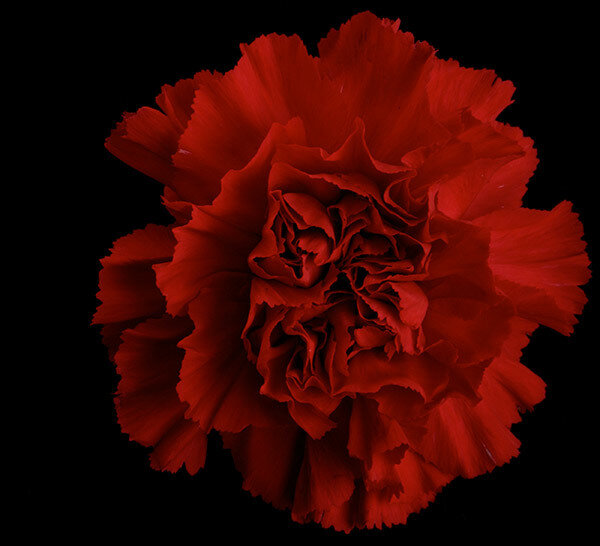
In Japan, everyone gives carnations on Mother’s Day. If you ask why, they shrug. Some might say that carnations are a symbol of mothers. Ask why, and they'll shrug again.

The thing with "traditions" in Japan is that a lot of them are imported. And, more often than not, the country from which the custom was adopted has itself long stopped doing it. The traditional school uniform for boys here is a high collared black jacket with buttons down the front. This came from Prussia over a hundred years ago. The sailor uniforms, too, were adopted from, I think, the clothes a British prince was wearing a century ago and the principal of a school I worked for adopted it as the school's uniform. It took off from there, becoming standard in Japan.

Mothers Day was also imported, most likely from the US, introduced in the postwar years by Christian missionaries. There was a different Respect Mothers Day that was the birthday of the Empress before the war, but like many of the pre-1945 holidays that were related to the Emperor they got thrown out or repackaged.

So, again, I suspect that Christian missionaries brought the custom of giving carnations to mothers on Mother’s Day. Why carnations? Because legend has it that carnations started to grow where the Virgin Mary's tears fell when she saw Jesus carrying the cross pass by.

I had never heard of this and looked up the Stations of the Cross to see if there was any mention of it. The 4th Station of the Cross (Traditional) is where Jesus meets his mother. Nothing about carnations or flowers there, so I still don't know how that all got started.

From Wiki: "Out of the fourteen traditional Stations of the Cross, only eight have a clear scriptural foundation. Stations 3, 4, 6, 7, and 9 are not specifically attested to in the gospels (in particular, no evidence exists of station 6 ever being known before medieval times) and Station 13 (representing Jesus's body being taken down off the cross and laid in the arms of his mother Mary) seems to embellish the gospels' record, which states that Joseph of Arimathea took Jesus down from the cross and buried him."

In Life in Japan Tags Japan's Imported Traditions, Mother's Day, Mother's Day in Japan, Carnations
Comment
P1020090.JPG

Chabitsu

May 10, 2021

Learned a new Japanese word yesterday: 茶櫃 (chabitsu).

Most chabitsu today are squat round wooden containers for keeping sencha (煎茶, medium grade tea), but 櫃 (hitsu) originally referred to large wooden lidded chests used for storage. This one is used to store antique kimono.

In Life in Japan Tags Chabitsu, 茶櫃, Storage Container
Comment
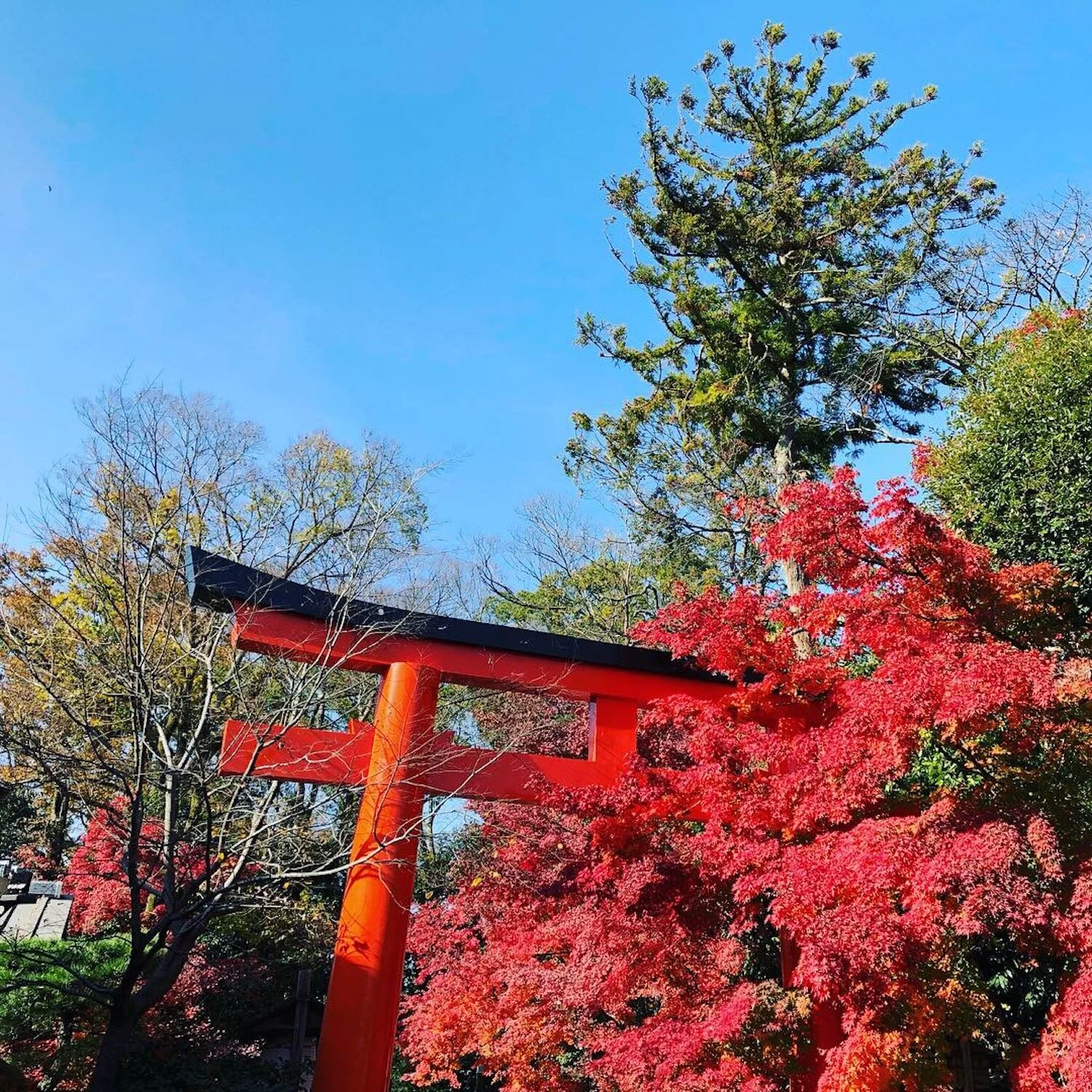
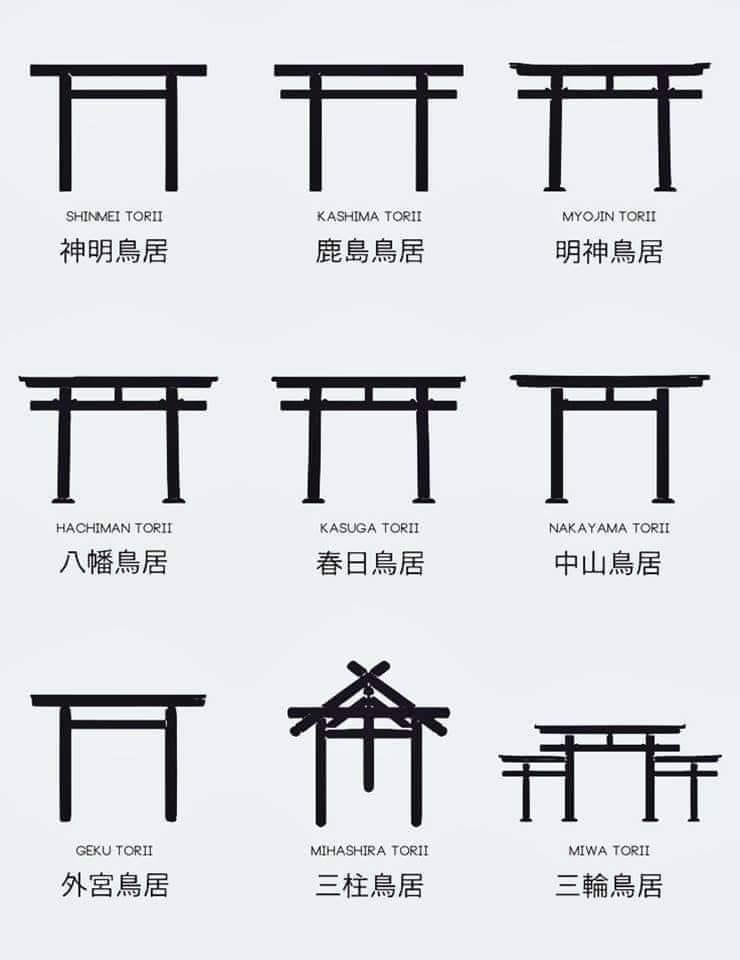
Myōjin torii – kasagiand shimaki arecurved upwards.

Myōjin torii – kasagiand shimaki arecurved upwards.

Torii

April 25, 2021

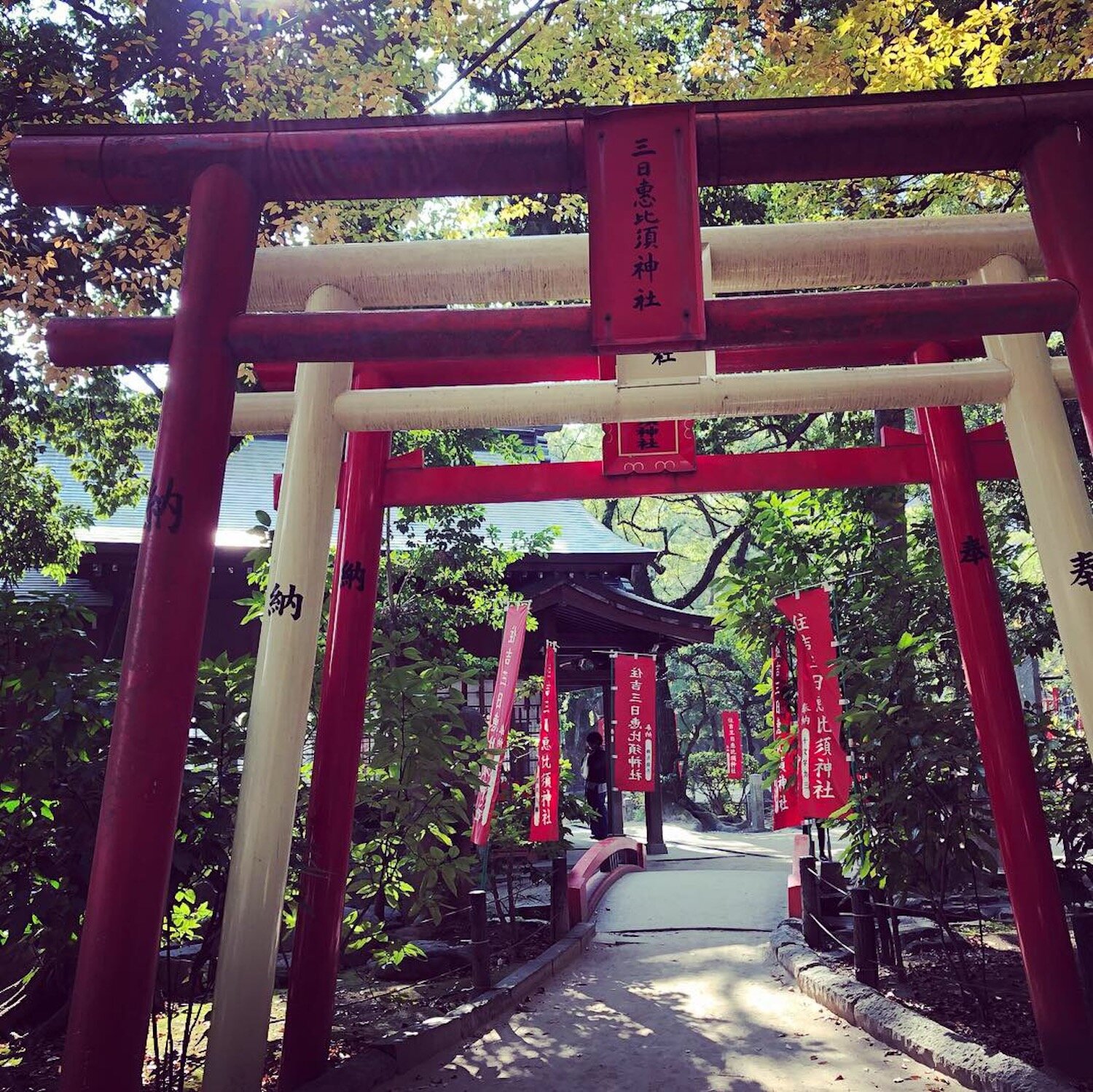
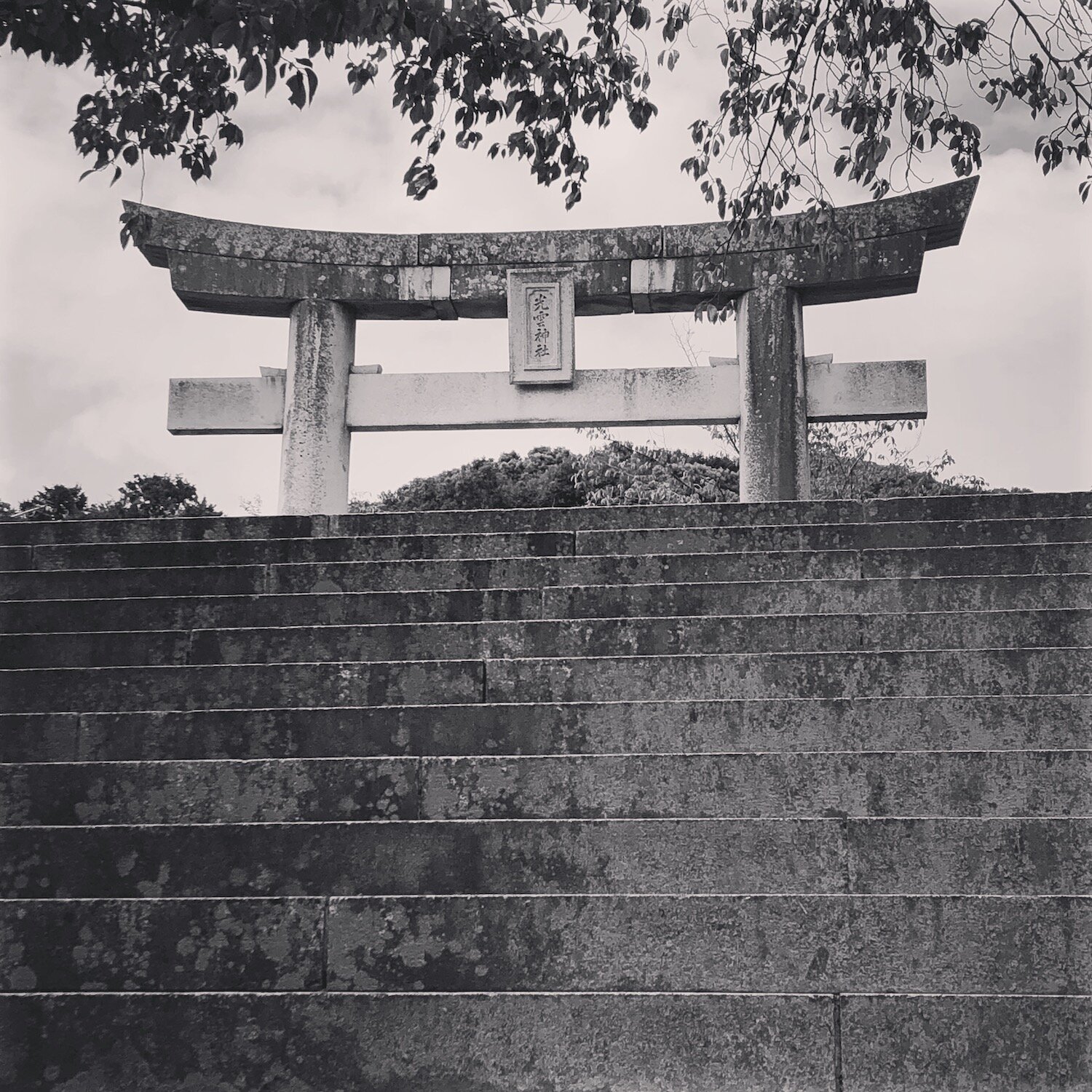
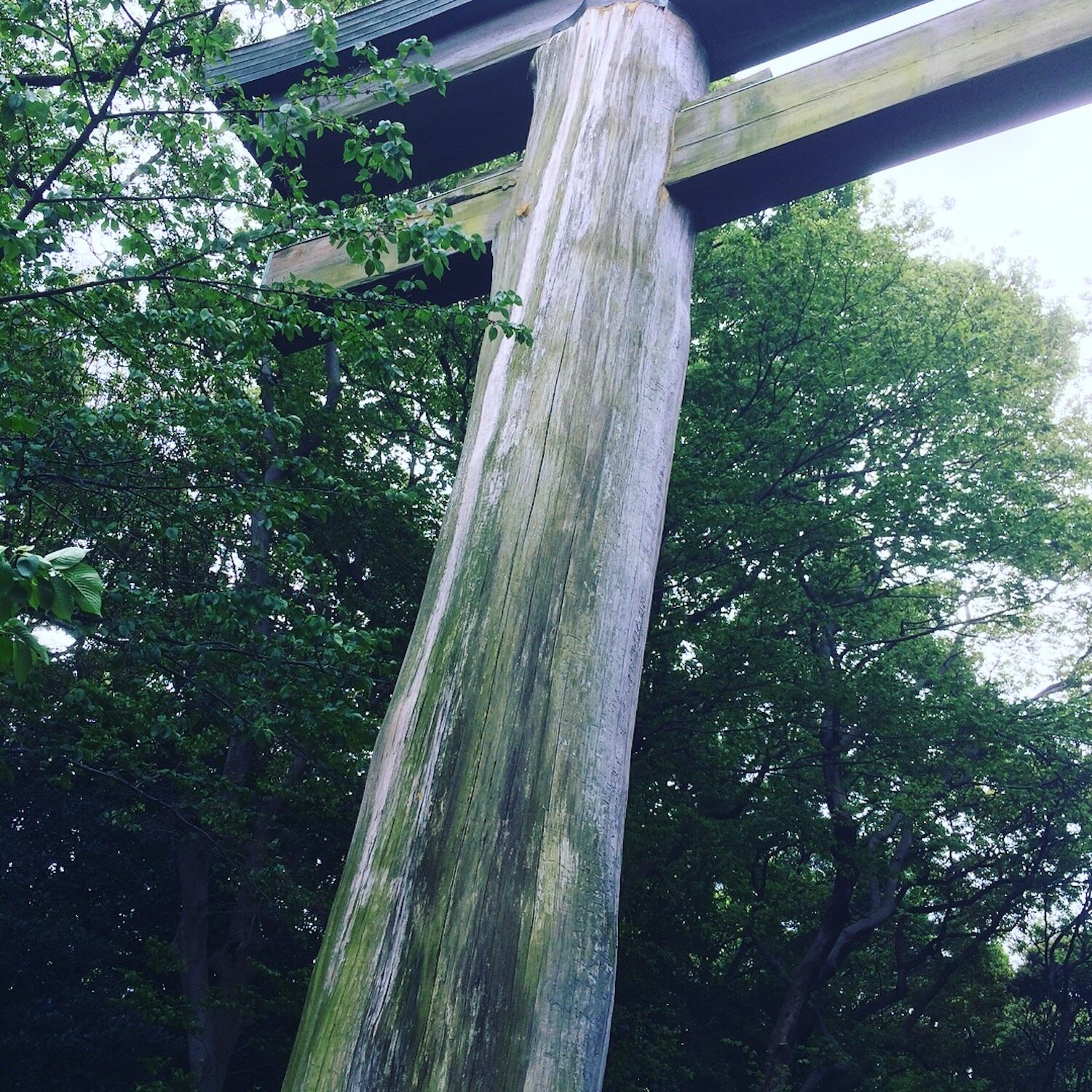
Torii (鳥居) are formalized gateway arches signifying the transition from the mundane world to a sacred area. Shrines may have one or multiple torii. When multiple torii are present, the largest one is usually called the ichi no torii (一ノ鳥居, the first torii), and stands at the approach to the overall shrine. Torii may also be found at various points within the precincts to indicate increasing levels of holiness as you approach the honden (本殿, main sanctuary).

IMG_2551.jpeg
IMG_1577.jpeg

Torii first appeared in Japan around the mid-Heian Period (794-1185) and were probably introduced to Japan from Tang China via Korea as Buddhism spread east. It is believed that torii originated in India from the torana gates in the monastery of Sanchi in central India.

Torana, also known as vandanamalikas, are free-standing arched gateways in the Hindu, Buddhist, and Jain architecture fo South, Southeast, and East Asia. In addition to Japaense torii, Chinese páifāng gateways (牌樓), Korean hongsalmun (홍살문, 紅箭門), and Thai sao ching cha (เสาชิงช้า) have their roots in the Indian torana.

IMG_2390.jpeg
The hizen torii (肥前鳥居) is an unusual type of torii with a rounded kasagi and pillars that flare downwards.

The hizen torii (肥前鳥居) is an unusual type of torii with a rounded kasagi and pillars that flare downwards.

IMG_4950.jpeg
IMG_3203.jpeg
IMG_1374.jpeg
IMG_2740.jpeg
IMG_2886.jpeg
01.jpg

A torii is usually formed from two upright hashira, (柱, posts) topped by a horizontal shimagi (島木, tie beam) and kasagi (笠木, cap beam) that extends beyond the posts on either side; beneath the kasagi a horizontal nuki '(貫, tie beam) is mortised through the uprights, linking them together. At the center of the nuki there may be a supporting strut called gakuzuka (額束), sometimes covered by a tablet carrying the name of the shrine. Based on this elemental form, a variety of formal styles are found at shrines, depending on the overall style of shrine architecture employed and the character of the central saijin (祭神, deity) enshrined within.

In Japanese Architecture, Religion Tags Shinto, Shinto Shrine, Shintoism, Torii, เสาชิงช้า, sao ching cha, hongsalmun, 홍살문, 牌樓, páifāng, Torana
Comment
n-spanishflu-a-20190509.jpg

Japanese Pandemic Posters from 100 Years Ago

April 2, 2021

When it comes to pandemics, we humans should be able to say been there, done that, but our collective consciousness can be foggy. Adopting new habits of social distancing, mask wearing, and heightened hygiene might feel new to us, but these are things that our grandparents and great-grandparents also had to do when diseases spread.

The posters here are mostly from a pandemic handbook published when the Spanish flu was raging. I will translate the advice later.

Japan-pandemic-manual-1920-1.jpg
EaOVRKTX0AAKIfb.jpg
japan-spanish-flu-posters-5.jpg
japan-spanish-flu-poster-1918.jpg
PH000468.jpg
PH000460.jpg
PH000465.jpg
japan-mandemic-manual-top.jpg
EaOVO4YWsAEC1B6.jpg
mask-and-gurgle.png
In Coronavirus Tags Pandemic Posters from the Past, Spanish Flu in Japan
Comment
1891501652277714.jpg

Okobo

April 2, 2021

. . . a soft voice called out from behind us: “Sunmahen.”

Turning around, I found a maiko mincing our way.

“Kannindossé,” she said as she passed. [1]

You could barely contain your excitement: “Wasn’t she the most adorable thing you’ve ever seen!”

We watched her walk away in that affected manner of a geisha, then disappear around a corner.

“I’ve never told anyone this, but I wanted to become a maiko myself when I was young.” [2]

“Is that so?”

“No one would have believed it. I was always so boyish as a child, climbing trees, doing karaté . . .”

“Karaté?”

“Yes, I have a green belt.”

“I’ll have to remember to never make you angry.”

“Ha-ha. Anyways, I was always playing dodgeball with the boys in my class. And now that I think about it, I didn’t even wear a skirt until junior high school when I had to because of the uniform. Until then, I was always in pants or shorts . . . Still, in the bottom my heart, I wanted to be dolled up like a maiko, and get fussed over by men. My sister, on the other hand . . .”

“You have a sister?”

“Yes, a younger sister. She’s in college right now. Mana . . .”

“Mana?”

“Yes, Mana. Kana and Mana. We once had a golden retriever called Sana-chan.”

“Funny.”

“Anyways, that sister of mine is the personification of Yamato Nadeshiko.[3] Wide-eyed, skin as white as milk, shy, but coquettish at the same time. She’s shorter than me and slightly plump, but in a good way. At any rate, she’s awfully cute and boys have been throwing themselves at her ever since she was in the fifth grade of elementary school. It’s no use fantasizing . . .”

“Oh, why not?”

“I was always too tall for one.”

“Too tall?”

“They say it all depends on the okiya, but there is a height limit of between one-hundred fifty-five centimeters and one-hundred sixty-five.” [4]

“I didn’t know that.”

“One reason is that the girls share their kimonos so they need to be about the same height. Another reason is that with their hair done up and the okobo sandals they have to wear, a maiko’s height is increased by about fifteen centimeters. I was already one-hundred sixty centimeters tall in junior high school.”

“And with all the get-up, you would have been one hundred and seventy-five centimeters tall. Interesting. I never considered that.”


[1] Sunmahen (すんまへん) is how sumimasen (すみません), or “Excuse me”, is pronounced in Kyōto and neighboring areas. Kannindossé is Kyōto-ben, or Kyōto dialect, for gomen nasai, or “Sorry” or “Pardon me”.

[2] Maiko (舞妓) is an apprentice geiko (芸妓). Traditionally aged 15 to 20, they become full-fledged geiko after learning how to dance, play the shamisen, and speak the Kyōto dialect.

[3] Yamato Nadeshiko (大和撫子) is the personification of an idealized Japanese woman: namely, young, shy, delicate.

[4] Between 5’1” and 5’5”.


The first chapter of A Woman’s Tears can be found here.

注意:この作品は残念がらフィクションです。登場人物、団体等、実在のモノとは一切関係ありません。

All characters appearing in this work are unfortunately fictitious. Any resemblance to real persons, living or dead, is purely coincidental.

This and other works are, or will be, available in e-book form and paperback at Amazon.

In Dating, Japanese Customs, Japanese Language, Japanese Women Tags Maiko, Kyoto, Gion, Hanamachi, Nadeshiko, Okiya, Okubo Sandals, Kyoto Dialect
Comment
LQAT7364.jpeg

Chigi and Katasogi

March 28, 2021

Honden (本殿) – main hall, enshrining the kami (神). On the roof of the haiden (拝殿) and honden (本殿) are visible chigi (千木, forked roof finials) and katsuogi (鰹木, short horizontal logs), both common shrine ornamentations.

Katsuogi (鰹木, 堅魚木, 勝男木, 葛緒木) or Kasoegi (斗木) are short, decorative logs found in Shinto architecture. Placed at a right angle along the ridge of roofs, they predate Buddhist influence and are an architectural element endemic to Japan.

In ancient times, katsuogi were used as symbols of status or rank on the houses of members of the court and other powerful families, but they later came to be used only on the major structures of shrines.

Chigi are believed to be a vestige of primitive construction practices in which roofs were formed by crossing and binding together ridge-support poles, the extended tops of which were left uncut.

The original purpose of chigi was as a functional reinforcement to the structure, but today, most serve as symbols emphasizing the sacred nature of the structure.

At the Grand Shrines of Ise, shrine buildings dedicated to male kami are traditionally given an odd number of katsuogi and the ends of chigi are cut perpendicular to the ground, while shrines to female kami have an even number of katsuogi, and chigi are cut parallel to the ground.

The ends of the diagonal chigi are cut at mitered angles either perpendicular (sotosogi) or parallel (uchisogi) to the ground, leading to the alternate name katasogi ("miters").

In Japanese Architecture, Religion Tags chigi, 千木, katsuogi, 鰹木, Grand Shrines of Ise, sotosogi, uchisogi, katasogi
Comment
Abacus.JPG

Kakeibo: Making Ends Meet in Japan

March 26, 2021

I am a big fan of the Nobuko Takahashi Kakeibo[1] Clinic, an advice column published in Fukuoka’s Living Magazine, and have been reading it for many years. In the column Ms. Takahashi answers personal finance questions posed by Japanese housewives and gives advice on how to deal with the challenges facing their families. It offers an unusually candid look into the personal finances of the typical Japanese family.

In one of her more recent posts, a 28-year-old housewife and mother of a five-month-old baby girl wonders if it might be better to buy a house sooner rather than later.

The housewife writes:

“My husband and I married two years ago. Wishing to devote myself to raising our child, I quit my job and became a stay-at-home mother. Compared to when my husband and I were both working, our income is now half what it used to be. Although I’m somewhat uneasy about our finances, I enjoy raising our daughter and, because our home is a happy one, it hasn’t been hard for us to cut down on expenditures.

“First off, we reduced our pocket money and took a second look at what we had been spending on our cellphones. We seldom, if ever, eat out, and are able to economize by cooking for ourselves at home. Large expenditures, such as insurance are paid in annual installments and we’re trying reduce costs wherever possible. We also put aside a little every month. My husband’s varies by as much as 100,000 yen a month depending on how much overtime pay he earns. Our expenses, on the other hand, are fairly stable at the amounts I have indicated below.

“Recently, my husband’s parents have suggested that we build a house near theirs and we’re now thinking of buying one in the near future. I’ve heard, among other things that the tax deduction for homeowners will be reduced and the tax on property increased, so I’m wondering if we should make haste in buying a home or wait. Also, how much cash should we put down? We’re taking another look at our insurance premiums to see if we can save money there. We look forward to hearing from you.”


Mr. & Mrs. T of Kitakyūshū City

Husband (31), Wife (28), Daughter (5 months)


Income

Husband’s monthly income                                  240,000 yen

Children’s allowance from government                13,000 yen

                                                                        253,000 yen per month


Rent                                                                  58,000 yen

Food                                                                  26,000 yen

Utilities                                                              18,000 yen

Cellphones (2)                                                    15,500 yen

Misc.                                                                    2,000 yen

Medical Costs                                                       1,000 yen

Gasoline                                                            20,000 yen

Entertainment                                                     5,000 yen

Misc.                                                                  15,000 yen

Child Care Related Costs                                       7,000 yen

Husband’s Allowance                                           30,000 yen

Wife’s Allowance                                                  10,000 yen

Wife’s Life Insurance                                             2,000 yen

Education Insurance                                             5,000 yen

Car Insurance                                                       5,000 yen

Total                                                                  219,500 yen

Surplus                                                               33,500 yen


Annual Bonus                                                    960,000 yen


Annual Costs

Car Insurance (2 cars)                                         85,000 yen

Car Inspection                                                   100,000 yen

Husband’s Life Insurance                                    38,400 yen

Educational Insurance                                       116,000 yen


Savings

Husband’s Savings (1)                                    2,200,000 yen

Husband’s Savings (2)                                    5,300,000 yen

Wife’s Savings                                                2,200,000 yen

Child’s Saving                                                   200,000 yen


Before I go on to Takahashi's advice, I'd like to point out that the husband earns a modest annual salary of 3.8 million yen, or about $38,000 a year. The two of them, however, have ¥9.9 million (or $99,000) in savings. According to CNN/Money's net worth calculator, the average median net worth for an American in Mr. & Mrs. T's age group is only $8,525, and $34,375 for his income level. 

Japan is commonly believed to be an expensive place to live as evidenced by melons selling for a hundred dollars each. But in actuality, it can be an easy place to sock your money away. Medical costs, thanks to an excellent national healthcare system are unbelievably low, rent is reasonable if you’re willing to compromise on location and size, public transportation makes owning a car with all its related costs unnecessary, and taxes are not very high.


Takahashi replies:

“Even though your income has been reduced by half, you still manage to run a monthly surplus and have already saved close to 10 million yen. What’s more, you have the goal of building your own home and are putting effort into saving money to that end. Keep up the good work.

“You asked when the best time to buy a house was. Earlier is not always better. It’s important to keep in mind that there are three periods in a person’s life when they can purchase a home.

“The first is when low interest rates, tax deductions, a fall in house prices, and so on make it advantageous for you to buy a house.

“The second is related to your life cycle. You should determine whether it is a good time to move by looking at the start of your child’s entry into a new school or the needs of your parents and so on.

“And the third, is by looking at your personal finances. Can you safely buy a home—have you got enough money to put up front and is your situation stable enough for you to afford to make payments?

“It is ideal when all three of these come together at the same time, but you should at least prioritize the second and third points. In your case, you need to check whether there is a chance that your husband will be transferred in the future, and you should think about your relationship with his parents. You should also look into how much more you are able to save from now on and how much you’ll be able to spend on a house. Until you do that, you won’t be able to determine how much you of a down payment you should make.

“You also need to be careful about rises in the interest rate, reductions in the deduction for homeowners, supply and demand, and so on. A fall in the supply of building materials and carpenters, for example, can cause the price of building a home to rise considerably, which makes it easy for construction companies to cut corners.

“You might want to also take a second look at purchasing some additional life insurance for your husband. If necessary, you can always work full time, but if you add a life insurance policy to your home loan, you can receive up to 10 million yen in the event that your husband passes away. Otherwise, you might want to take out another policy on your husband.”


Whaddya think?


[1] A kakeibo (家計簿) is a family account book. Any Japanese housewife worth her salt (almost wrote “worth her mustard”) will keep a detailed record of her family’s expenditures and keep a the purse strings tight.

In Life in Japan, Married Life Tags Kakeibo, Managing Household Finances, How Much Do Japanese Earn, Making Ends Meet in Japan, Buying a House in Japan
Comment
IMG_1485.JPG

Gokusho Walkabout

March 24, 2021

I went to Gokusho (御供所) to see the cherry blossoms yesterday. This old neighborhood located in Fukuoka City's Hakata Ward has some of Japan's oldest temples including the nation's first zen temple (Shofukuji 聖福寺).

IMG_1486.JPG

The gojū-no-tō, or five-storied pagoda at Tōchōji (東長寺)

IMG_1489.JPG

Tōchō-ji (東長寺)

IMG_1492.JPG

Tōchō-ji (東長寺)

IMG_1496.JPG

Jōten-ji (承天寺) Completed in 1242, this temple is said to be where udon, soba, manjū and yōkan originated, all of which were introduced to Japan by Buddhist priests from the mainland.

IMG_1499.JPG
In Life in Fukuoka, Spring in Japan Tags Fukuoka City, Walking Tour of Fukuoka, Gokusho Machi, Sakura, Cherry Blossoms, Origin of Udon, Origin of Soba, Origin of Manju, Origin of Yokan
Comment
Day+1.jpeg

Pounding the Tokyo Pavement

March 23, 2021

 Originally posted in May of 2012

Earlier last month I went to Tōkyō to get a feel for the city. I suspect I will be spending more time there in the coming months and years to promote my writing and explore opportunities. This time, however, I didn't have much of a plan or anyone in particular to meet so I wandered about the city for three days. 

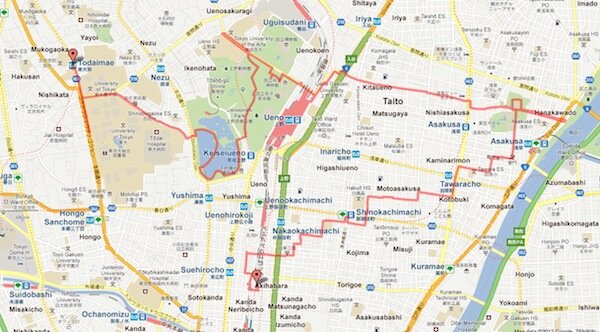
The map above shows the course I walked on my first day. I arrived at Haneda in the morning, put my luggage in a coin locker at Shinagawa Station and then headed for Harajuku. After a visit to Meiji Jingū, my second time in about fifteen years, I made my way towards the English gardens. Unfortunately, it was at the peak of the cherry blossom-viewing season and the lines were unlike anything I had ever seen before. No thanks! I soldiered on towards Akasaka Palace, which I had no idea existed before, then on to the National Diet building and other governmental places of interest. 

It was in front of the Diet that I met a former student and friend of mine who had relocated to Tōkyō about six years earlier. We walked to the Imperial Palace, said "Hey" to the Emperor and then continued on towards Tōkyō Station, the Bank of Japan, the original Mitsukoshi, and Nihon Bashi.

It was late in the afternoon by the time we made our way back to the Maru Bldg so we popped into a wine bar and had a few drinks then parted ways.

After checking into my hotel, I went for another walk around Shinagawa, but didn't find much of interest. If I am not mistaken, my ex-wife now lives in a high-rise condo near the station. As fate would have it, we did not meet. We must not have had en after all.

I walked close to 30,000 steps that Sunday.

Walk.2.jpeg

On the second day, I took the train to that Mecca of Geekism, Akihabara, but as it was still early on Monday morning nothing much was going on. Oh well.

From Akihabara, I took a meandering course through Taitō Ward and made my way to Asakusa. Whereas my first day's walk was a trip through the elegance of Meiji/Taishō Era Japan, this was my shita machi tour of no nonsense working class neighborhoods.

I visited Sensōji, the great temple in Asakusa, then went to the Sumida River to gawk at the Sky Tree that was scheduled to open on the 22nd of the month. From there, I doubled back, passing through the temple grounds again, and headed up the Kappa Bashi Dōri which took me to Ueno.

After wandering around Ueno Park and the neighboring buildings and universities, I made my way to Tōkyō University which was far better looking than I expected. Half of the students, of course, looked “retarded”, and the campus had that unmistakable sour smell of male virginity. 

From Tōdai, I hopped on a train and went to Shinjuku which promised a Lebanese restaurant called "Simbad" of all things. They had Almaza beer from Lebanon and Arak which was a treat after the distance I had trekked. The drinks put me in the mood for a smoke, so I googled shisha cafes and discovered two promising joints in Shimo-Kitazawa, a neighborhood I had never heard of before but would over the years become quite familiar with.

(Let me tell you, I would still be lost in Tōkyō today if I didn't have the GoogleMap app on my iPhone. In 2012, the app was still something of a novelty.)

I spent about three hours in Shimo-Kitazawa smoking a nargileh and chatting with people. It was the start of the highlight of my trip.

I returned to my hotel in the late afternoon, took a short nap, then headed back out and met that former student/friend of mine for dinner in Hirō.

Incidentally, when I first came to Japan I bought a phrase book which had the old rōmaji spellings. Hirō was spellt Hiroo, so I used to think that the neighborhood's name rhymed with "kangaroo" rather than "hero".

Live and learn.

Yūko and I had an excellent dinner at Cicada. A delicious mélange of Lebanese, Turkish, Greek dishes. And the service was impeccable. More on that in another post.

After Cicada, we walked to Ebisu where we had drinks at Bar Martha, easily in my all-time top five bars. On the way, I happened to pass by HachiHachi, one of the many yaki-niku restaurants owned by my next door neighbor in Fukuoka. The English menus at the restaurant are mine, by the way. It was odd being so far from home and coming across something I had written a few years ago.

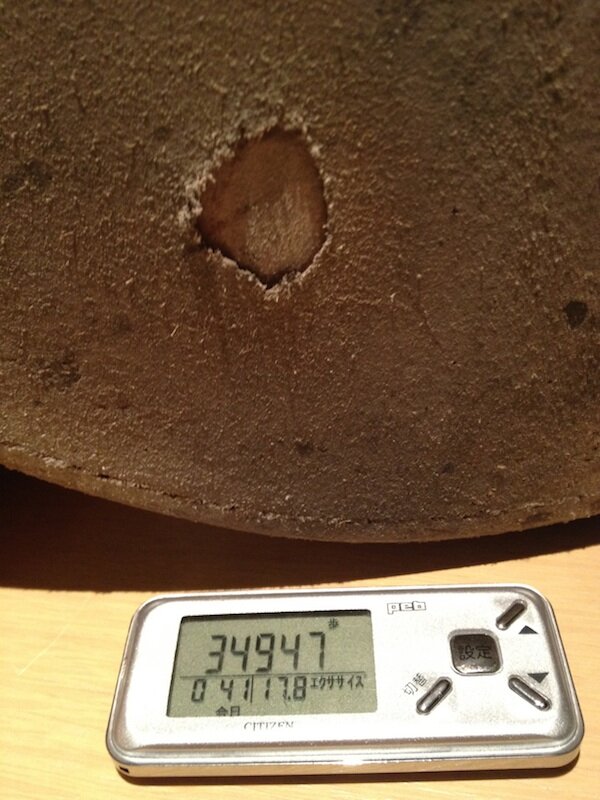
By the time I got back to my hotel, my dogs were dead tired. I had walked almost 35,000 steps, a new record for me and the soles of my Tricker's had sprung a leak.

Sole.jpg

On the following Tuesday, I relied more on the public transportation, taking the train or subway whenever possible. 

In the morning I visited the Foreign Correspondents Club. Unfortunately, it was too early. I had intended on setting myself on fire to gain some publicity for my works. No luck. From there, I walked up to the old Court House which is almost as beautiful and grand as Tōkyō Station. I then took a train to Shinjuku where I had a drink at the Park Hyatt after which I headed out to Timbuku to the Museum of Modern Art. Both the Hyatt and the museum were something of let downs.

By now, I was ready to go home. Fetching my things from a locker in Shinagawa Station, I hopped on a train bound for Haneda where I was able to get onto an earlier flight. 

All in all, I walked over sixty kilometers during the course of those three days. And while I didn't get one step closer to promoting myself or my book, I was happy to have at least gotten to know Tōkyō somewhat better. 

I'll be back soon.

(And back I was very soon.)

In Wanderlust, Walkabout, Travel Tags Walking Tour of Tokyo, Walkabout Tokyo
Comment
DSC02712.jpg

Chiyoda Walkabout

March 22, 2021

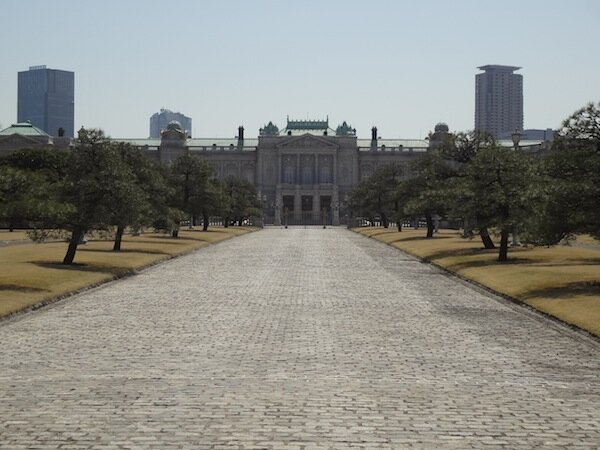
One of the things that surprised me when I first wandered about Tōkyō a decade ago was how much open space there was. Walking from Meiji Jingū towards the Imperial Palace I passed several large parks and chanced upon the Akasaka Palace (pictured above and below). Many of the wide boulevards did not have the overhead cobweb of electric cables and telephone wires that Fukuoka had, so you had an unobstructed view of the sky above. How refreshing! I had expected to find a soulless concrete jungle. What I discovered, however, was quite the opposite. I liked it so much that I returned to Tokyo a few months later, then again and again—two, three, even four trips a year—over the next ten years.

This was my first of many walks in the capital.

DSC02714.JPG

Akasaka Palace (赤坂離宮, Akasaka rikyu), or the State Guest House (迎賓館, Geihinkan), is one of the two state dues houses of the Government of Japan, the other being the Kyōto State Guest House. The palace was originally built as the Imperial Palace for the Crown Prince (東宮御所, Togu gosho) in 1909. Not too shabby.

In 2012 when I first stubbled upon the palace, it was closed to the public. A few years later, they opened it up. One of these days, I’ll try to get a peak inside.

DSC02716.JPG

venue leading from Akasaka Palace towards Hibiya.

IMG_1618.JPG

Den of Thieves, also known as the headquarters of the Liberal Democratic Party, which is neither very liberal or democratic. But they are the only game in town, I’m afraid, after the Democratic Party’s dismal response to the Tōhoku Earthquake and Tsunami of 2011.

This photo was taken in 2012 and boy, what a difference a decade makes. Regardless or your political leaning, you can’t help admitting that the LDP really pushed through a number of reforms that changed life in Japan. Whether those changes were for the better, I’ll leave that up to you. I will say this: where I was once skeptical of Abe’s second stint as PM, near the end I had to say he had been effective, transformational even. If the pandemic never happened, where would we be today?

IMG_1620.JPG

As is often the case, the Japanese Diet was closed for business when I came a-knockin'. One day I would like to take a tour of the building if that is possible.

The Diet building has been destroyed by Godzilla in the past, but was spared the Allies’ bombs in WWII. There is an interesting interview of Faubion Bowers who was the assistant to the assistant of Douglas MacArthur during the Occupation. He mentions that all the good areas of Tokyo were not bombed because the Americans and Allies intended to use the buildings after the war.

DSC02730.JPG

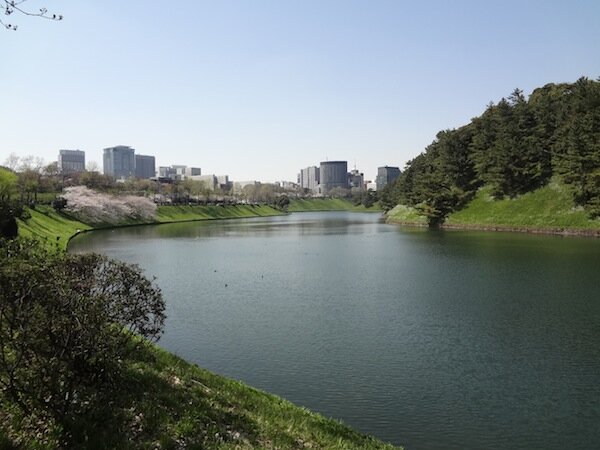
Moat surrounding the Imperial Palace. It was tempting to strip down to my skivvies and jump in.

DSC02731.JPG

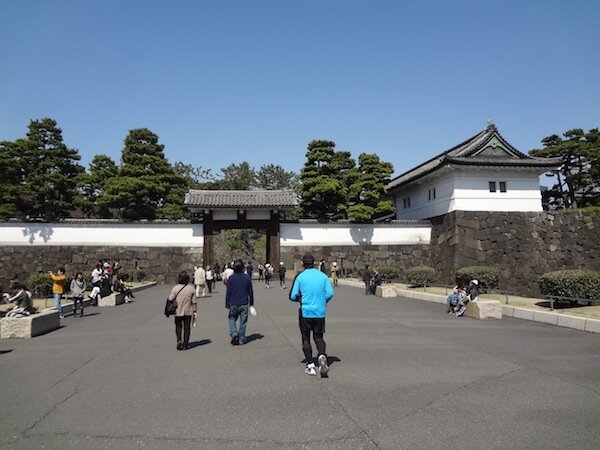
Western gate leading to the Imperial Palace

DSC02734.JPG

The Sakuradamon Gate, location of the Sakuradamon Incident of 1860 when Chief Minister Ii Naosuke was assassinated by rōnin of the Mito and Satsuma Domains after the Treaty of Amity and Commerce with the US was signed.

DSC02738.jpg

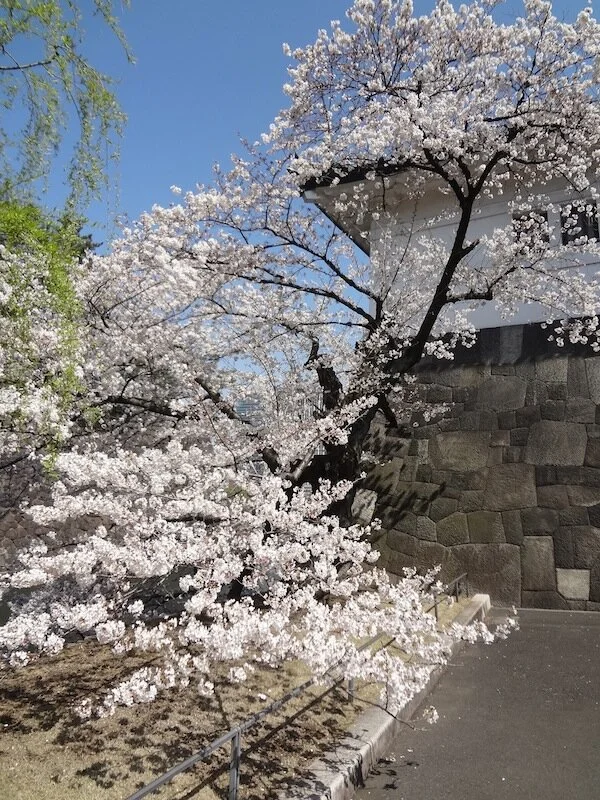
Cherry blossoms at the Cherry Blossom Field Gate (Sakuradamon).

DSC02824.JPG

View from Marunouchi Building of the park before the Imperial Palace. This wide open space was also rather unexpected. I really love the Marunouchi area, which I have written about elsewhere.

DSC02971.JPG

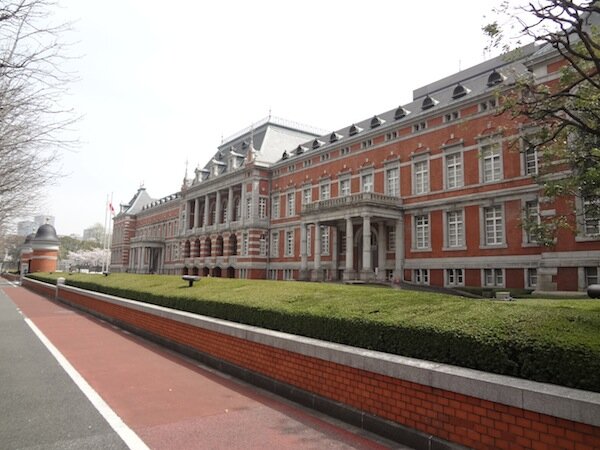
The 19th century building housing the Ministry of Justice is located across the street from the Imperial Palace.

In Walkabout, Travel, Japanese History, Japanese Architecture Tags Tokyo Walk, Chiyoda, Walking Tour of Tokyo, Imperial Palace, Ministry of Justice building, Diet Building, Akasaka Palace
Comment
BETiXop5.jpeg

How could we lose?

March 21, 2021

Mit solchen Brüsten, wie können wir den Krieg verlieren? Unvorstellbar!


In Oddball
Comment
Write.jpg

The Loneliness of . . .

March 21, 2021

My favorite band at the moment is a group that is not yet very well known outside of the U.K.: Elbow. Fantastic music with lyrics that resonate in your head long after the songs have ended. Elbow has cracking good tune called The Loneliness of a Tower Crane Driver, which, I’ve read, is about the loneliness that can result from ambition and success. It's worth a listen.

Anyways, wife and I were talking the other day about a friend of a friend, the producer of the film CUT[1]. Apparently the actors, staff, and producer of the film were all in New York promoting the movie at the Tribeca Film Festival.

“How nice it must be,” my wife said, “to be able to go together as a team and say, ‘Look what we did!’ Nothing could be more different than writing a novel.”

I couldn't disagree with her. No other profession is as steeped in loneliness as that of the novelist. Ideas are borne out of the individual’s imagination, developed in the mind, and then composed in silence. It can take years to complete a single work—my second novel Rokuban (No.6) took three years to write and I’m still tweaking and editing it a year and a half after “publication”.

Kurt Vonnegut once said that the reason writer’s give speeches is to hear people clap: “I used to make speeches all the time. I needed the applause.” And, I do, too. Unfortunately, that applause, which is virtual in nature, does not come in standing ovations, the screams of teenage girls or canned laughter, but rather in subdued messages e-mailed to me by kind readers. Followed by more silence.

I struggle with words and sentences, trying to hold on to this mother tongue of mine as it slips through my fingers. Twenty years learning and “mastering” another language so different from your own, and then spending more time with words that are like borrowed clothing that don’t quite fit so well or look quite right on you, trying to produce something that other’s can read, enjoy, identify with . . . Sigh.

And then, some bastard gives you one star and says it was excruciating trying to read what you had spent years in unpaid solitude writing.

There’s no accounting for taste, of course. One man’s meat is another man’s poison, or so the saying goes.

To console myself, I went to amazon.com to read the pans of two of my favorite authors: Kurt Vonnegut and Gabriel García Márquez. Vonnegut’s classic Slaughter House 5 received a one-star rating, the worst, by thirty-four reviewers and Márquez’s Love in the Time of Cholera had no less than 59 detractors, one of whom deign to give the Hunger Games Trilogy five stars. Some people should limit their reviews to dog food. 

One of the major problems with writing as an art is that it takes great effort to appreciate a work. A video on YouTube can be watched in two or three minutes' time and, if you like it, you can click “thumbs up”. No effort needed there. A photo on Facebook can be "liked" almost as quickly as it is viewed which is one reason I never get excited when people praise my photography. When it comes to a novel, though, you’re asking a total stranger to invest a week or more of his time, to use his imagination as he reads every single one of the fifty to seventy thousand words that make up the work. Just finding the time to sit down and start reading something takes effort. So, it’s no wonder people can be unforgiving of typos, the occasional “creative” phrasing, or bad writing.

I sometime wonder if I would have been a less maladjusted individual if only I had pursued a different art altogether. Tap-dancing, for instance.


[1] CUT - an Amir Naderi film in Japan

In Writing Life Tags Elbow, The Loneliness of a Tower Crane Driver, Tribeca Film Festival, Rokuban, Kurt Vonnegut, Gabriel García Márquez, Book Review
Comment
← Newer Posts Older Posts →

Latest Posts

No results found

Subscribe

Sign up with your email address to receive news and updates.

We respect your privacy.

Thank you!
Blog RSS

Blog

Featured
Hikyaku Courier.png.webp
May 17, 2026
Hikyaku
May 17, 2026
May 17, 2026
Why do Fukuoka Schools Celebrate in May.png
May 16, 2026
The May Miracle: Why Fukuoka’s Schools Are All Celebrating Right Now
May 16, 2026
May 16, 2026
533578549_779743457907505_9184140746382917063_n.jpg
August 19, 2025
Fighting in the Pacific Theater Post August 15
August 19, 2025
August 19, 2025
que-12241102027.jpg
March 26, 2025
 Meiji Modernization and German Influence
March 26, 2025
March 26, 2025
Screenshot 2025-02-04 at 6.21.14.png
February 4, 2025
Risshi-Shiki
February 4, 2025
February 4, 2025
政党の変遷_20181001.jpg
November 3, 2024
Japan's Political Parties
November 3, 2024
November 3, 2024
EB9D8A29-A874-400F-9D59-619E85CFD8C5.png
September 9, 2024
Keio JR High School’s Entrance Exam
September 9, 2024
September 9, 2024
Sinburyou.jpg
March 25, 2024
Shinburyo
March 25, 2024
March 25, 2024
GH1mAHXXUAAaJgc.png
March 18, 2024
Survival Japanese
March 18, 2024
March 18, 2024
Usui.jpg
February 20, 2024
Usui
February 20, 2024
February 20, 2024

INSTAGRAM

View fullsize All ready for Thanksgiving.

#shochu #imojochu #焼酎 #いも焼酎
View fullsize Display Cases of Kyoto
View fullsize Inuyarai in Kyōto 

京都の犬矢来

Found under the eaves of townhouses (machiya) in Kyoto and along the road, inuyarai were originally made of split bamboo. In modern times, however, they are sometimes made of metal. The original purpose of the arched barri
View fullsize Walls in Gokusho Machi, Hakata
View fullsize The 15th of August is the last day of the Bon Festival of the Dead, Japan’s version of Dia de muertos. On this day, Japanese say goodbye to the spirits of their ancestors. Today I say goodbye to my last drop of Yamato Zakura Beni Imo 35%. Forgi
View fullsize Azaleas at Fukuoka’s Kushida Shrine 

#櫛田神社 #Kushida #springinjapan #Fukuoka
View fullsize Mugon (Tacit, lit. Without Words) rice shōchū genshu from Sengetsu Distillery of Hitoyoshi, Kumamoto. Aged in cypress casks, I believe, it retains that telltale hinoki scent. I normally don’t drink Kuma-jōchū, but this is lovely. I’ll buy
View fullsize Another one of my somewhat hard-to-find favorites. Sang Som from Thailand. So smooth. I used to keep a bottle of it at Gamaradi before the pandemic. May have to do so again. Missed it. Missed Mr. Chang.
View fullsize First drink of the New Year is the best find of the past year: 

Yaesen Shuzō genshu #awamori from #Ishigaki Island. Aged in oak barrels, it has the nose of whiskey, the mellow sweet taste of a dark rum. At ¥5000 a bottle, it’s rather price
View fullsize Santa arrived early and just in time for Labor Thanksgiving Day 🇯🇵 

Two bottles of imo shōchū—one is a favorite, the other an interesting find I happened across during a short visit last summer to the Koshiki archipelago off the western coas
View fullsize Mission accomplished!

Dropped by the new Flugen in Hakata to drink one of my all-time favorite spirits, the somewhat hard-to-fine-but-worth-the-search Linie Aquavit from Norway.

#Flugen #Aquavit #Hakata
View fullsize Two or three weeks ago a friend invited me to join him at a big shōchū and awamori wingding at #FukuokaDome. Ended up buying about ten bottles of booze which I have stashed away at the in-laws’ for safekeeping. Of all the things I bought, this
View fullsize Takumi has once again included Maō in one of their #shochu box sets. At ¥5550, it’s not a bad deal. 

Kannokawa genshū—another favorite of mine made with anno sweet potates from Tanegashima—sold me. Ended up buying two. 

#かんぱい
View fullsize A little present to myself to mark the midpoint of the semester. Easy coasting from here.

Cheers and kampai!

#いも焼酎 #imoshochu #shochu #大和桜 #YamatoZakura
View fullsize Naha, Okinawa

#マンホール #Manhole #Naha #Okinawa #shisa #シーシャ
View fullsize At American Village in Chatan, Okinawa.

#北谷 #マンホール #沖縄 #Manhole #Chatan #Okinawa
View fullsize Final bout lasted 8 seconds. So, I guess it’s safe to say we’ve got that fickle momentum back.

#Karate #空手 🥋 #Kumite #組手
View fullsize 京都ぶらぶら

A long, slow walk through Kyōto
View fullsize 京都ぶらぶら

Kyōto stroll
View fullsize Always good to visit with my fellow traveler.

Gourmets of the world unite!
IMG_3919.jpg

KAMPAI Blog

Featured
Screenshot 2024-02-07 at 17.39.19.png
February 7, 2024
60 : 35 : 5
February 7, 2024
February 7, 2024
1614050579_3.jpg
May 15, 2023
Satsuma Imo Motogusare Disease
May 15, 2023
May 15, 2023
Seifuku Imuge.jpeg
June 22, 2021
Seifuku's Imugé
June 22, 2021
June 22, 2021
May 24, 2021
Kachaashii
May 24, 2021
May 24, 2021
MCHS1968.jpeg
May 16, 2021
Destine
May 16, 2021
May 16, 2021
April 26, 2021
Moriawaro
April 26, 2021
April 26, 2021
March 3, 2021
Kampai Shanshan
March 3, 2021
March 3, 2021
IMG_2395.jpeg
January 28, 2021
Mitake Genshu
January 28, 2021
January 28, 2021
Kikoji.jpeg
January 27, 2021
Kokubu Kikoji Kura
January 27, 2021
January 27, 2021
Hakaio.jpeg
January 15, 2021
Hakaio
January 15, 2021
January 15, 2021
rokuban+wing+2.jpg

Too Close to the Sun

Featured
February 20, 2019
80. Why the long face?
February 20, 2019
February 20, 2019
February 20, 2019
79. The Itch
February 20, 2019
February 20, 2019
January 24, 2019
78. Soaring
January 24, 2019
January 24, 2019
January 23, 2019
77. Yaba Daba Doo!
January 23, 2019
January 23, 2019
January 3, 2019
76. Let's Make a Deal
January 3, 2019
January 3, 2019
November 22, 2018
75. The Pied Piper of Patpong
November 22, 2018
November 22, 2018
November 16, 2018
74. Ping Pong Pussy
November 16, 2018
November 16, 2018
October 18, 2018
73. Yaba
October 18, 2018
October 18, 2018
October 16, 2018
72. Lightning Strikes Twice
October 16, 2018
October 16, 2018
October 10, 2018
71. Contacting De Dale
October 10, 2018
October 10, 2018
A Woman's Tears.jpg

A Woman's Tears

Featured
April 2, 2018
18. Just When I Stop Looking
April 2, 2018
April 2, 2018
April 1, 2018
17. Catch and Release
April 1, 2018
April 1, 2018
March 29, 2018
16. Nudging Destiny
March 29, 2018
March 29, 2018
March 25, 2018
15. HAKATA RESTORATION PROJECT
March 25, 2018
March 25, 2018
March 20, 2018
14. Reversible Destiny
March 20, 2018
March 20, 2018
March 12, 2018
13. Graduation
March 12, 2018
March 12, 2018
March 12, 2018
12. Reading Silence Aloud
March 12, 2018
March 12, 2018
March 7, 2018
11. Shut Out
March 7, 2018
March 7, 2018
March 6, 2018
10. The Second Night
March 6, 2018
March 6, 2018
February 28, 2018
9. At the farmhouse
February 28, 2018
February 28, 2018

Silent Ovation

Featured
Ovation.11.png
February 27, 2024
11. High School
February 27, 2024
February 27, 2024
Screenshot 2024-02-11 at 4.25.37.png
February 11, 2024
10. Taichiro Remarries
February 11, 2024
February 11, 2024
Screenshot 2024-02-05 at 6.24.29.png
February 5, 2024
9. Death of My Father
February 5, 2024
February 5, 2024
hand1.gif

A Woman's Hand

Featured
January 24, 2019
52
January 24, 2019
January 24, 2019
January 24, 2019
51
January 24, 2019
January 24, 2019
January 23, 2019
50
January 23, 2019
January 23, 2019
January 3, 2019
49
January 3, 2019
January 3, 2019
November 22, 2018
48
November 22, 2018
November 22, 2018
unnamed-1.jpg

A Woman’s Nails

Featured
CHHn-rqUIAA4iPq.jpg
February 21, 2021
14. Nekko-chan
February 21, 2021
February 21, 2021
71e7595d28eb0d7d76becf80c766aba2_3.jpg
February 20, 2021
13. Tatami
February 20, 2021
February 20, 2021
February 18, 2021
Yoko (Extended Version)
February 18, 2021
February 18, 2021
197512.jpg
February 18, 2021
11. Yoko
February 18, 2021
February 18, 2021
February 17, 2021
10. Yumi
February 17, 2021
February 17, 2021
00006204.jpg
February 16, 2021
9. Mie
February 16, 2021
February 16, 2021
aonghascrowe-reina-2.jpeg
February 11, 2021
8. Reina
February 11, 2021
February 11, 2021
mie-6.jpg
February 10, 2021
7. Mie
February 10, 2021
February 10, 2021
aonghascrowe-reina-3_4.jpg
February 4, 2021
6. Reina
February 4, 2021
February 4, 2021
abeoto-gravure-image5-52.jpg
February 3, 2021
5. Machiko
February 3, 2021
February 3, 2021
Schechter.Bavel_.TowerofBavel.jpg

HOGEN/Dialect

Featured
March 25, 2026
Shichigatsu Bushi
March 25, 2026
March 25, 2026
Okinawa Shimi.jpg
March 22, 2026
シーミー: Okinawa’s Unique Ancestor Picnic Festival
March 22, 2026
March 22, 2026
Yoisho.png
March 19, 2026
Regional Ways Japanese People “Lift Themselves Up”
March 19, 2026
March 19, 2026
Uwabaki.2.jpg
April 17, 2024
Uwabaki
April 17, 2024
April 17, 2024
chinsuko.jpg
April 9, 2024
Chinsuko
April 9, 2024
April 9, 2024
Scan.jpeg
March 17, 2024
The Snack with 100 Names
March 17, 2024
March 17, 2024
Minsa Ori.1.jpg
February 26, 2024
Minsa Ori
February 26, 2024
February 26, 2024
71a4db62b521cf61e57d092101ed1615.jpg
February 7, 2024
Taicho ga Warui
February 7, 2024
February 7, 2024
DTa7CejVoAAGPWU.jpg
August 17, 2023
Hashimaki
August 17, 2023
August 17, 2023
img01.png
August 16, 2023
Dialects of Japan
August 16, 2023
August 16, 2023
Articles.jpg

Articles

Featured
GPBlog_SummerHomework(GaijinPot_iStock-1024x640.jpg
August 27, 2021
With Friends Like These
August 27, 2021
August 27, 2021
スクリーンショット 2021-06-11 20.22.21.png
June 13, 2021
2 Seasons
June 13, 2021
June 13, 2021
952-LW-illo.jpg
April 14, 2019
High Time for Summer Time
April 14, 2019
April 14, 2019
onomatopoeia.jpg
June 18, 2018
Potsu Potsu: Japanese Onomatopoeia and the Rain
June 18, 2018
June 18, 2018
point-card-lead.jpg
May 19, 2018
Point Break
May 19, 2018
May 19, 2018
last-word-01-860x480.jpg
May 2, 2018
F.O.B. & A-Okay
May 2, 2018
May 2, 2018
Cathay.fukuoka-guide.jpg
April 4, 2018
Fukuoka Guide: Spring 2018
April 4, 2018
April 4, 2018
IMG_4503.jpg
February 12, 2018
Woman Kinder-rupted
February 12, 2018
February 12, 2018
expo_25.jpg
February 11, 2018
Summer of Loathing
February 11, 2018
February 11, 2018
Electtttt-2.jpg
February 11, 2018
Election Primer
February 11, 2018
February 11, 2018

Play With Me

Featured
IMG_0541.jpg
January 21, 2018
January 21, 2018
January 21, 2018
IMG_1318_2.jpg
January 21, 2018
January 21, 2018
January 21, 2018
IMG_1319_2.jpg
January 21, 2018
January 21, 2018
January 21, 2018

Please Write

Featured
IMG_0862.jpg
January 21, 2018
January 21, 2018
January 21, 2018
IMG_1145_2.jpg
January 21, 2018
January 21, 2018
January 21, 2018
IMG_1417.jpg
January 21, 2018
January 21, 2018
January 21, 2018
1000 Awesome Things About Japan

1000 Awesome Things About Japan

Featured
Peas and rice.jpeg
February 26, 2020
8. Peas Gohan
February 26, 2020
February 26, 2020
Finders, Keepers.jpg
January 16, 2019
7. Finders, Returners
January 16, 2019
January 16, 2019
Things+Love+About+Japan.6.1.jpg
October 10, 2018
6. No Guns
October 10, 2018
October 10, 2018
Lockers+IMG_8310.jpg
October 10, 2018
5. Coin Lockers
October 10, 2018
October 10, 2018
IMG_5676.JPG
September 11, 2018
4. Sentō
September 11, 2018
September 11, 2018
manu.jpeg
September 10, 2018
3. Uprightness
September 10, 2018
September 10, 2018
IMG_2220.jpg
September 6, 2018
2. Manhole Covers
September 6, 2018
September 6, 2018
On+Board.jpg
September 5, 2018
1. Flying in Japan
September 5, 2018
September 5, 2018
Featured
2nd Carrier Kido Butai.jpeg
December 5, 2021
5 December 1941
December 5, 2021
December 5, 2021
NYT 1 Dec 1941.png
December 1, 2021
1 December 1941
December 1, 2021
December 1, 2021

Powered by Squarespace